Why can carbon fiber sheets from different suppliers have noticeably different strength and prices, even when they are all 2 mm or 3 mm thick?
The key is simple: thickness is only a surface-level parameter and does not directly determine the strength of a carbon fiber sheet.
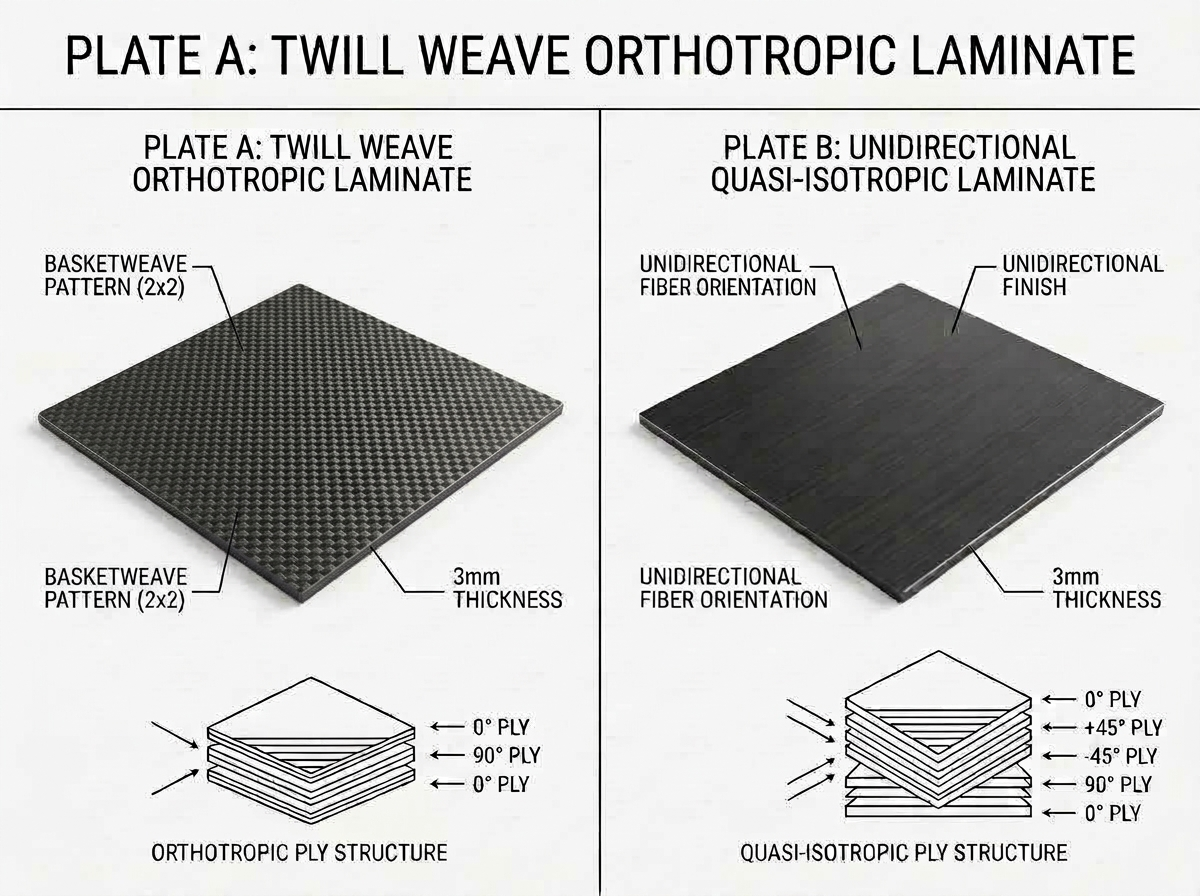
1. Why do carbon fiber sheets with the same thickness have different strength?
Because the strength of a carbon fiber sheet is not determined by thickness alone. Even if two sheets are both 3 mm thick, differences in fiber grade, fiber orientation, layup structure, resin system or manufacturing process can result in significant differences in strength and stiffness.
2. Does the fiber grade affect the strength of a carbon fiber sheet?
Yes. T300, T700, T800 and T1000 carbon fibers each have different characteristics in terms of strength and modulus. In general, higher-performance fiber materials also come with higher material costs.
So, the same thickness does not mean the same carbon fiber grade is being used.
3. Why does fiber orientation affect strength?
Carbon fiber has strongly directional properties.
0° fibers mainly carry axial loads, ±45° fibers are better suited for shear and torsional loads, while 90° fibers help improve transverse stability.
If the fiber orientation does not match the actual load direction, even a sufficiently thick sheet may not deliver its expected performance.
4. Why is the layup structure important?
The layup determines how fibers in different directions are combined.
At the same 3 mm thickness, one sheet may be dominated by 0° layers and optimized for longitudinal tension, while another may combine 0°, ±45° and 90° layers to handle tension, shear and transverse loads.
That is why thickness alone is not enough when selecting a carbon fiber sheet. The internal layup also matters.
5. Does the resin system affect carbon fiber sheet performance?
Yes. Resin does more than simply hold the fibers together. It also affects toughness, temperature resistance, interlaminar bonding and long-term durability.
Different operating environments may require different resin systems. This is another important reason why sheets with the same thickness can perform differently.
6. Does a higher fiber content always make the sheet stronger?
Not necessarily. Increasing fiber content appropriately can improve mechanical performance, but excessive fiber content may affect resin impregnation and interlaminar bonding.
A well-designed carbon fiber sheet needs a proper balance between fiber content, resin ratio and overall structure.
7. Does the manufacturing process affect carbon fiber sheet strength?
Yes. The molding method, curing temperature, pressure control, resin impregnation and interlaminar quality can all affect final performance.
Even when the material specifications are identical, defects such as voids, delamination or insufficient curing can reduce actual strength and consistency.
8. Is it enough to compare only thickness and price when purchasing?
Not recommended.
If two suppliers both offer 3 mm carbon fiber sheets, you should compare more than price. Check the fiber grade, layup structure, fiber orientation, resin system and manufacturing process as well.
9. How do you choose the right carbon fiber sheet?
First determine what type of loads the sheet will actually experience. Then define the required strength, stiffness and thickness.
For custom projects, it is also important to specify dimensions, fiber orientation, layup requirements, machining tolerances and operating environment.
GBTECH can provide material and layup recommendations based on the specific application.
10. What should you focus on when comparing carbon fiber sheets with the same thickness?
Don’t look at thickness alone. Pay particular attention to the fiber grade, fiber orientation, layup structure, fiber content, resin system and manufacturing quality.
Simply put:
Thickness determines “how thick it is.”
The material and structure determine “what it can handle.”
If you are comparing different carbon fiber sheet solutions, you can provide the dimensions, thickness, application, performance requirements and quantity to contact GBTECH for material selection, custom solutions and a quotation.
https://gbtechmaterials.com/SendInquiry/
https://gbtechmaterials.com/Carbon-Fiber-Sheets/
Official GBTECH Websites:
Email: zane@gbtechgroup.cn
Phone: +1 (510)902-9987
www.gbtechgroup.cn | www.gbtechcomposites.com | www.gbtechmaterials.com
US.Office: 38758 Buckboard Common, Fremont, CA 94536, United States
China Head Quaters: Building 1, Left Side, Tangye Road, Xinxu, Huiyang, Huizhou, China


 WhatsApp
 E-mail