After carbon fiber sheets and tubes arrive, they are not always sent immediately into machining or assembly.
In many projects, materials may remain in storage for several days, weeks, or even longer. How they are stored and handled during this period can directly affect subsequent machining and assembly quality.
Although carbon fiber composites offer high strength and good dimensional stability, their edges, surfaces, and connection areas still require proper protection. Incorrect stacking, impacts, or prolonged exposure to unsuitable environments can cause unnecessary damage.
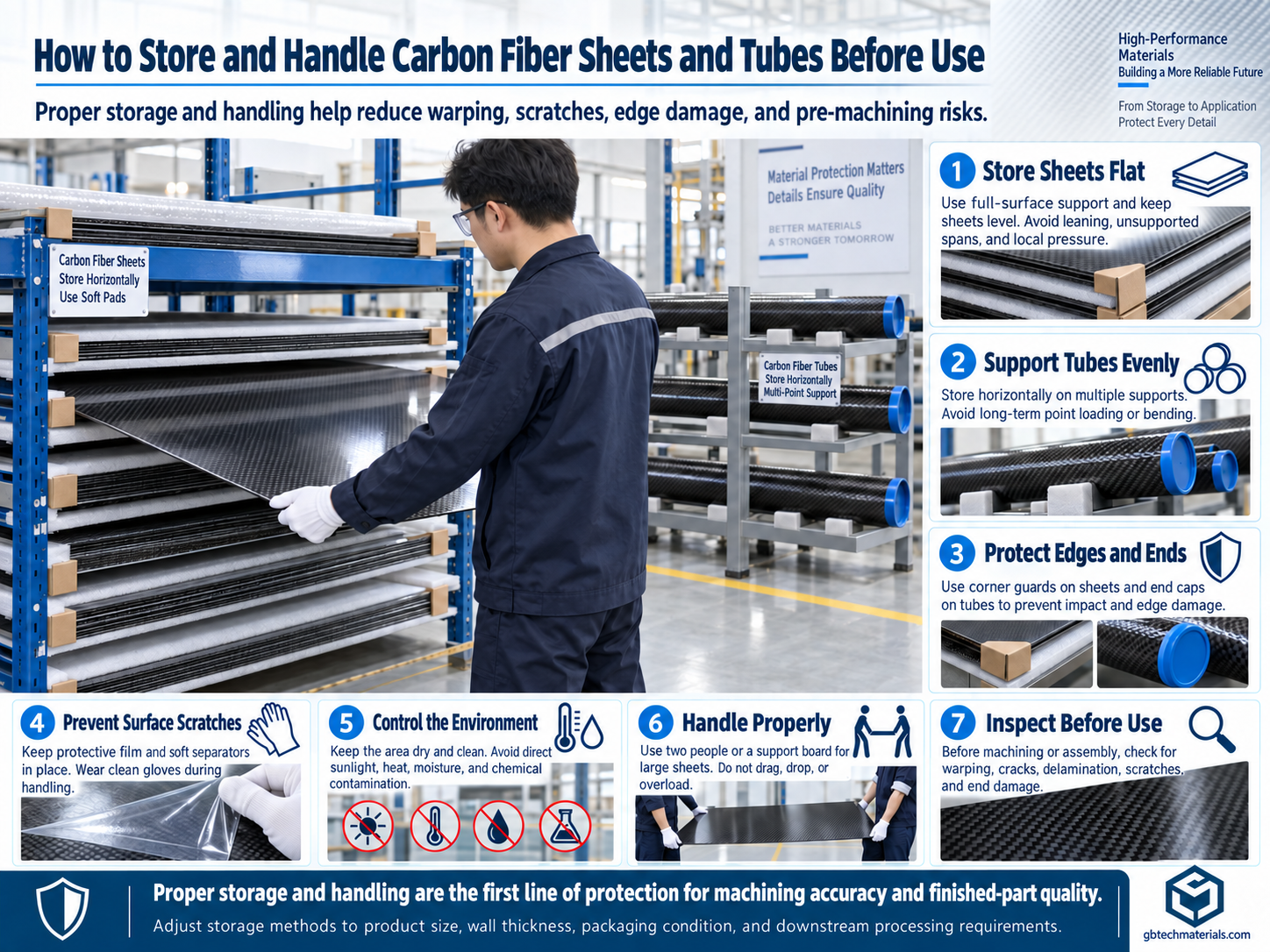
The most important requirement for carbon fiber sheets is to keep them flat.
They should preferably be stored horizontally on a dry, flat, and evenly supported surface. Long-term unsupported spans or single-point support should be avoided. For thinner sheets, uneven loading over an extended period may affect flatness.
Heavy objects should not be placed directly on carbon fiber sheets. Although the material has high overall strength, concentrated local pressure may still cause surface indentations or internal damage.
Sheet edges are also generally more vulnerable to impact than the central area. Foam, protective strips, or other soft materials can be used to protect and separate the edges during storage and handling.
Carbon fiber tubes should preferably be stored horizontally and supported with racks, blocks, or suitable padding.
If multiple tubes are stacked together, soft separators should be placed between them to prevent surface scratches caused by friction.
Special care should be taken with thin-wall carbon fiber tubes to avoid heavy loads from above. Although tubes may provide good load-bearing capability in certain directions, concentrated local compression can affect roundness or even cause damage that is not immediately visible.
For long-term storage, protecting the tube ends is also recommended to prevent impact damage, edge chipping, or delamination.
The main priorities during handling are to avoid impact and concentrated loading.
Do not drag carbon fiber sheets or tubes directly across floors, workbenches, or other surfaces, as this can scratch the surface or damage the edges.
For large sheets or long tubes, multiple people should work together during handling when necessary to reduce excessive bending caused by the material's own weight.
If lifting equipment is used, soft lifting slings or protective tools are preferable. Direct contact between metal lifting equipment and the carbon fiber surface should be avoided whenever possible.
Carbon fibers themselves have good environmental stability, but the resin matrix in a carbon fiber composite can still be affected by environmental conditions.
Prolonged exposure to elevated temperatures may influence resin performance, particularly in locations exposed to direct sunlight or close to heat sources.
High-humidity environments may also increase moisture absorption by some resin systems, potentially affecting subsequent processing or long-term performance.
For this reason, carbon fiber materials are best stored in a cool, dry, and well-ventilated environment and should not be exposed for extended periods to ultraviolet radiation, excessive moisture, or aggressive chemical media.
The appearance of carbon fiber products is often important to customers, but surface protection is not only about appearance. It can also affect subsequent machining quality.
Where possible, keep the original protective film in place during storage, or use soft materials to separate individual parts.
For tubes, particular attention should be given to protecting the ends. For sheets, the edges should receive additional protection.
If cutting, drilling, or CNC machining is planned, inspect the material beforehand for visible scratches, cracks, delamination, or signs of impact damage.
The appropriate handling method for large carbon fiber sheets depends on their size, thickness, and weight.
Large sheets are generally not suitable for single-person handling because the central area may bend under the sheet's own weight.
Multiple operators or suitable handling equipment can be used, and the transport path should be cleared in advance to prevent the sheet from hitting machinery, walls, or sharp objects.
For carbon fiber sheets with high cosmetic requirements, avoiding surface friction is especially important.
Under appropriate environmental conditions, finished carbon fiber sheets and tubes can generally be stored for extended periods.
However, actual storage performance depends on factors such as packaging, temperature, humidity, surface system, and the specific composite material.
For materials kept in long-term inventory, it is advisable to inspect the packaging and product condition periodically. Before machining or use, check dimensions, flatness, and surface condition.
During transportation, GBTECH selects protective packaging according to the size and shipping requirements of carbon fiber sheets and tubes and can provide appropriate storage recommendations to help reduce the risk of damage after delivery.
The final performance of a carbon fiber product depends not only on the material itself but also on how it is transported, stored, machined, and assembled.
Proper storage and handling can reduce unnecessary damage, improve machining consistency, and help carbon fiber sheets and tubes perform as intended in the final application.
If you are working with carbon fiber sheets, tubes, or custom components and have questions about storage, machining, or application, GBTECH can provide technical guidance and processing support based on your specific project requirements.
Send Inquiry:https://gbtechmaterials.com/SendInquiry/
View Carbon Fiber Sheet Specifications:https://gbtechmaterials.com/Carbon-Fiber-Sheets/
View Carbon Fiber Tube Specifications:https://gbtechmaterials.com/Carbon-Fiber-Tubes/
Official GBTECH Websites:
EMail: zane@gbtechgroup.cn
Phone: +1 (510)902-9987
www.gbtechgroup.cn | www.gbtechcomposites.com | www.gbtechmaterials.com
US.Office: 38758 Buckboard Common, Fremont, CA 94536, United States
China Head Quaters: Building 1, Left Side, Tangye Road, Xinxu, Huiyang, Huizhou, China


 WhatsApp
 E-mail