A carbon fiber part takes an impact and only shows a small mark on the surface. Can it still be used? If delamination appears along an edge, should it be repaired or replaced?
These questions cannot be answered by appearance alone.
Carbon fiber composites behave differently from metals. After impact, dents and deformation in metal are often relatively easy to see. In carbon fiber, some damage may remain hidden inside the laminate. The surface may look almost intact while the resin has already cracked or separation has developed between plies.
So the real question in carbon fiber repair is not simply “Can this be patched?” It is:
How deep is the damage, where is it located, and what does the part still need to do after repair?
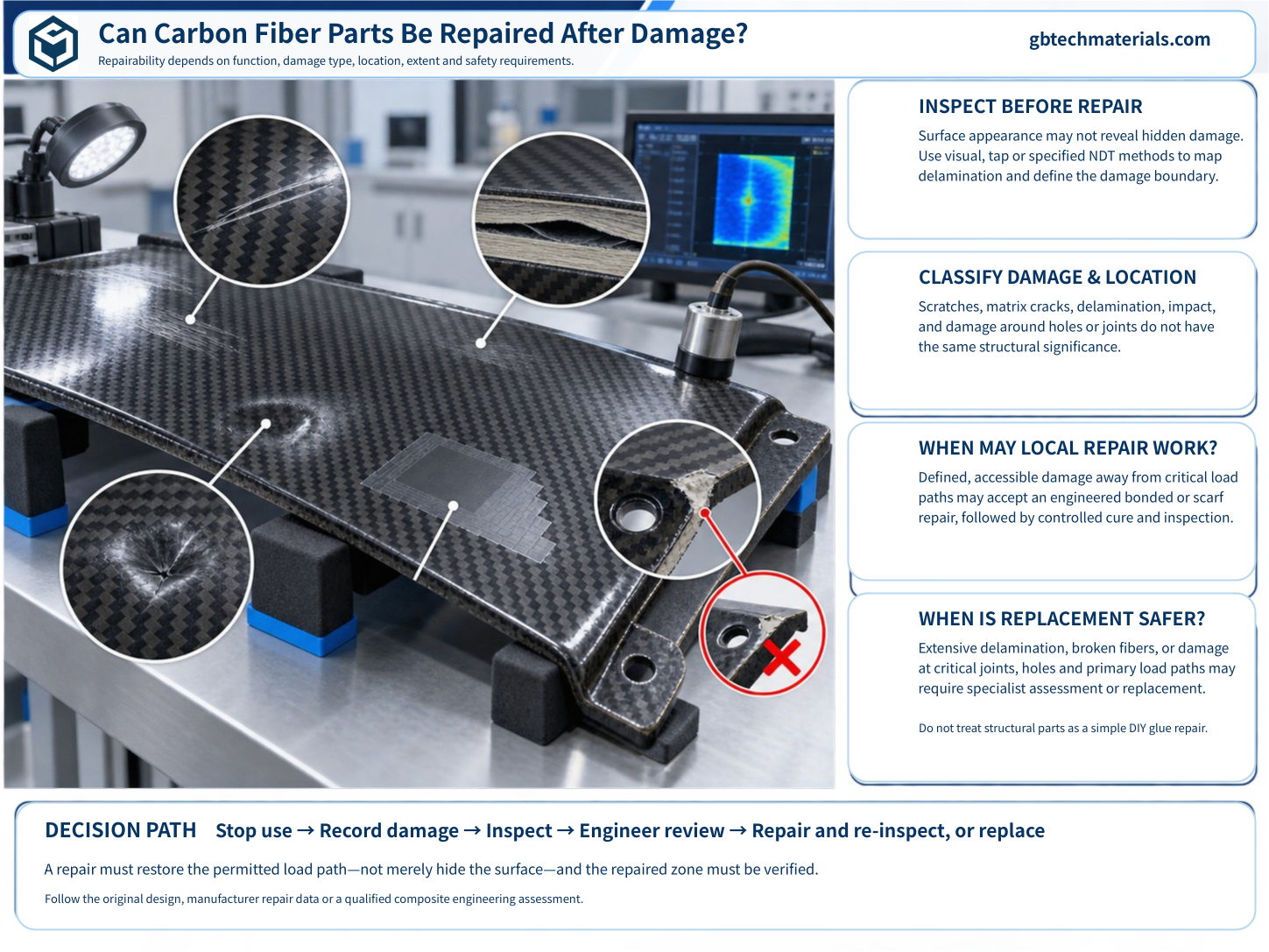 1. Can Every Damaged Carbon Fiber Part Be Repaired?
No. It depends on the type and location of the damage.
If the damage is limited to a minor scratch in the surface resin and the fibers are neither exposed nor broken, surface treatment may be sufficient. This can include local sanding followed by reapplication of resin or a protective coating.
However, if broken fibers, clear delamination, or damage around holes, joints, or primary load-bearing areas are visible, it should not be treated as a simple cosmetic repair.
Minor scratches, small edge chips, and some localized delamination may be repairable after the actual damage area has been confirmed.
For example, if the edge of a carbon fiber sheet is lightly damaged and the defect remains localized without propagating further into the laminate, the damaged area may be cleaned and repaired depending on the application.
Some localized delamination can also be repaired using composite repair methods such as scarfing or adding repair plies to help restore structural continuity.
However, the repair method should not be selected based only on the visible size of the damaged area.
The original laminate, loading direction, and service environment also need to be considered.
Not necessarily.
This is one of the reasons impact damage in carbon fiber composites can be underestimated.
An impact may leave only a small visible mark while causing matrix cracking or interlaminar separation internally.
This is especially important for thin sheets, tube walls, and joint areas, where visual inspection alone may not reveal the full depth or extent of the damage.
If the part is only cosmetic, visual inspection may be a reasonable first step.
If it carries structural load or the impact occurred in a critical location, the assessment should be more conservative. Where necessary, nondestructive inspection methods such as ultrasonic testing can be used to evaluate internal damage.
If there is extensive delamination, obvious continuous fiber breakage, structural deformation, or damage along a primary load path, repair and replacement should be compared carefully.
This is especially important for parts with higher safety requirements.
The question should not simply be:
“Can it still be used after repair?”
The more important questions are:
Can reliable load transfer be restored?
Can the repaired area be properly verified?
Can its condition continue to be monitored during service?
If these questions cannot be answered with sufficient confidence, replacement is often the more appropriate option.
In practice, the first question is usually not “How many centimeters long is the crack?”
The first question is:
What does this part actually do?
Is it a cosmetic cover or a load-bearing component?
Did the damage occur in a general area or around a hole, insert, or connection point?
Are the fibers broken?
Has the delamination propagated deeper into the laminate?
What tensile, bending, or torsional loads will the part still experience?
The same visible damage on an equipment cover and on a robotic structural arm should not be treated in the same way.
For custom structural components, it is better to evaluate the damage together with the original drawing, material system, laminate design, and actual operating conditions rather than making a repair decision from photographs alone.
It should not be assumed that a repaired part will automatically return to its original performance.
Repair effectiveness depends on factors such as damage extent, repair material, ply overlap or scarf geometry, surface preparation, curing conditions, and workmanship.
A properly designed repair can restore effective load transfer, but the actual level of recovered performance should be verified for the specific structure.
Professional assessment is recommended before continued use if there is fiber breakage, propagating delamination, visible cracking, deformation, or a significant impact event.
Holes, metal inserts, bolted joints, and other high-stress areas deserve particular attention because these locations already carry concentrated local loads.
If the damage extent cannot be confirmed visually, do not rush to grind or sand the surface.
Premature surface removal may destroy evidence needed to identify the source and actual extent of the damage.
A useful sequence is:
First confirm the damage, then determine whether it affects load-bearing capability, and only then decide whether to repair or replace the part.
Minor surface damage does not automatically mean the part must be discarded.
At the same time, damage affecting a critical load-bearing area should not be kept in service simply to reduce repair or replacement cost.
For procurement and maintenance teams, the decision should also consider repair cost, inspection cost, downtime, replacement lead time, and long-term reliability.
In some cases, repair is more economical. In others, manufacturing a replacement part is the more practical solution.
If your carbon fiber sheet, tube, or custom component has been damaged, GBTECH can help evaluate the appropriate next step based on the component's function, original structure, damage location, and actual operating conditions.
For parts that are not suitable for further repair, GBTECH can also assess a custom replacement solution based on the original drawing, sample, and assembly requirements.
Send Inquiry:https://gbtechmaterials.com/SendInquiry/
View Carbon Fiber Sheet Specifications:https://gbtechmaterials.com/Carbon-Fiber-Sheets/
View Carbon Fiber Tube Specifications:https://gbtechmaterials.com/Carbon-Fiber-Tubes/
Official GBTECH Websites:
EMail: zane@gbtechgroup.cn
Phone: +1 (510)902-9987
www.gbtechgroup.cn | www.gbtechcomposites.com | www.gbtechmaterials.com
US.Office: 38758 Buckboard Common, Fremont, CA 94536, United States
China Head Quaters: Building 1, Left Side, Tangye Road, Xinxu, Huiyang, Huizhou, China


 WhatsApp
 E-mail