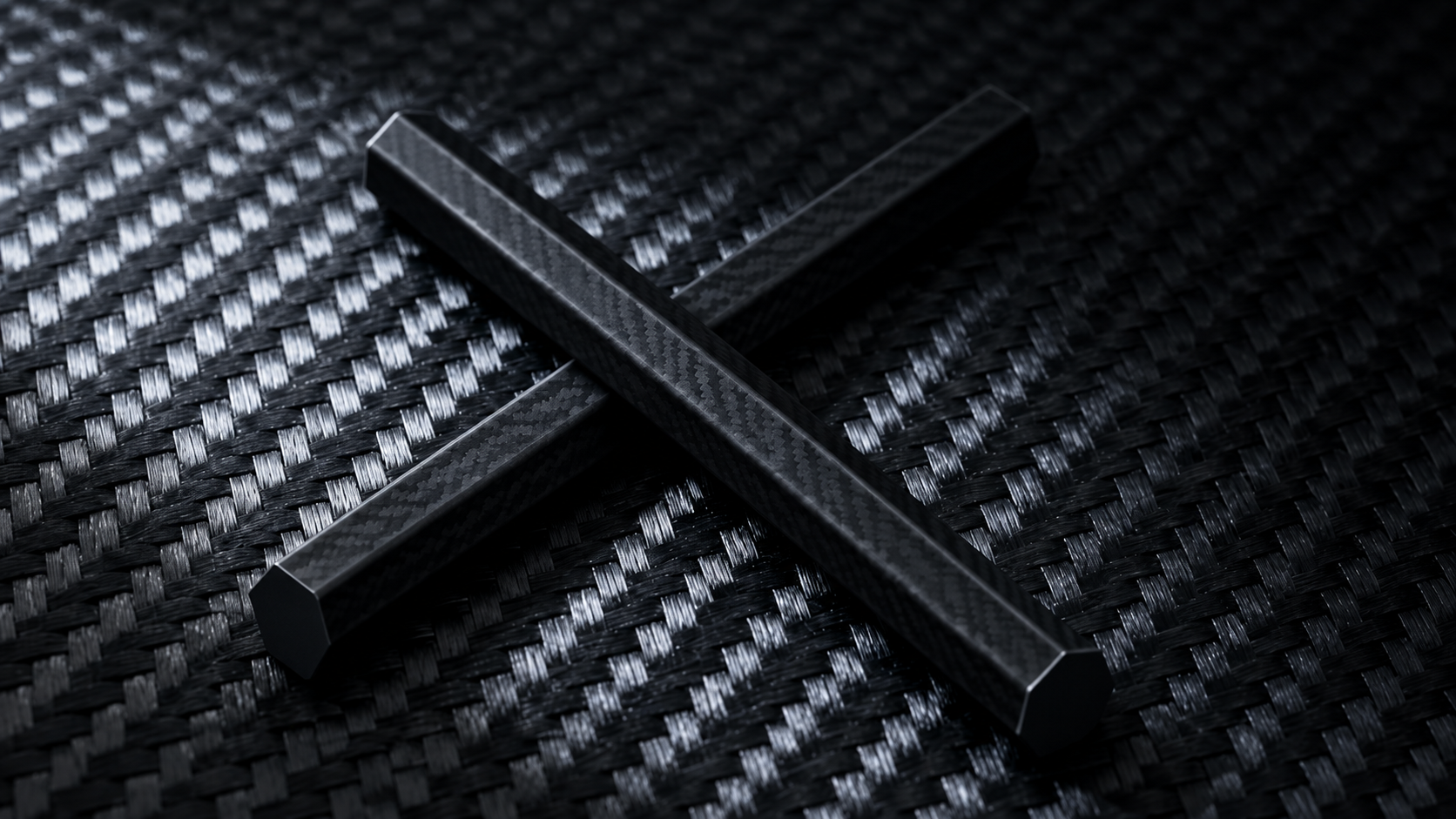
GBTECH 2000 mm hexagonal carbon fiber rod is a solid, hexagonal-profile composite rod made from continuous carbon fibers in an epoxy resin matrix. The hexagonal cross-section provides flat contact surfaces at six positions, which can resist rotation when the rod is clamped or inserted into a matching hexagonal bore. This makes it suitable for anti-rotation structures, positioning elements and instrument assemblies.
The 2000 mm format supplies one uninterrupted two-metre length for long members or cut-to-size production. It is useful when the designer needs freedom to establish final component lengths after a prototype or nesting review. This page supports the hexagonal rod product line and the search terms hexagonal carbon fiber rod, carbon fiber hex rod and pultruded hexagonal carbon rod.
Specification | Value |
Product name | Hexagonal Carbon Fiber Rod |
Form | Solid, hexagonal cross-section |
Process | Pultrusion (UD) |
Fiber type | 100% carbon fiber (T300, T700, T800) |
Fiber orientation | Unidirectional (0° along length) |
Matrix | Epoxy resin |
Common across-flats sizes | 8 mm, 10 mm, 12 mm, 15 mm, 20 mm (market standard; GBTECH available sizes to be confirmed internally) |
Standard length | 2000 mm |
Surface finish | Smooth, black |
Density (typical, pultruded CFRP) | 1.5–1.6 g/cm³ |
Tensile modulus (typical, unidirectional CFRP) | 130–165 GPa |
Tensile strength (typical, unidirectional CFRP) | 2800–3500 MPa |
Potential uses include anti-rotation structures, positioning elements, instrument frames, model structural members and lightweight shaped supports. The hexagonal profile is often used where a round rod would rotate under torque, or where multiple flat surfaces are needed for mounting. These are design directions, not certified load-bearing applications.
Carbon fiber is electrically conductive. Use appropriate dust control and personal protection during cutting, drilling and handling. Protect nearby electronics from conductive dust.
Confirm the across-flats dimension and corner geometry before designing mating parts. The hexagonal profile can be cut, drilled and bonded using standard carbon fiber composite tooling.
Why select a hexagonal rod instead of a round rod?
The hexagonal profile provides flat surfaces that resist rotation when clamped or inserted into a matching hex bore. Round rods can rotate freely unless additional keying or fastening is used.
What is the across-flats dimension?
The across-flats dimension is the distance between two opposite flat surfaces of the hexagon. It is the primary specification for a hexagonal rod. Confirm the across-flats dimension and tolerance before ordering.
Is the hexagonal rod pultruded or molded?
Hexagonal carbon fiber rods are typically pultruded with unidirectional fiber orientation. Custom shapes and sizes may require a dedicated die. Confirm the manufacturing route and available sizes with GBTECH.
Can it be cut to length?
Yes. The 2000 mm stock length can be cut to size. Calculate usable lengths after allowing for kerf, end trimming and finishing.
Request a quotation with the required across-flats dimension, length, quantity, surface finish and delivery country. Confirm pricing, packaging, availability and lead time with GBTECH before ordering.
Official GBTECH Websites:
EMail: zane@gbtechgroup.cn
Phone: +1 (510)902-9987
www.gbtechgroup.cn | www.gbtechcomposites.com | www.gbtechmaterials.com
US.Office: 38758 Buckboard Common, Fremont, CA 94536, United States
China Head Quaters: Building 1, Left Side, Tangye Road, Xinxu, Huiyang, Huizhou, China


 WhatsApp
 E-mail