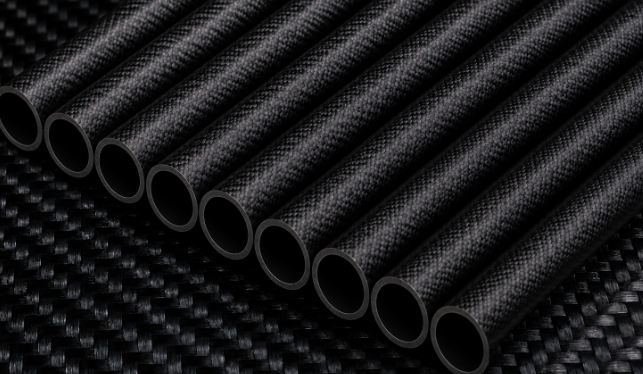
GBTECH heat resistant carbon fiber tube is a high-temperature structural tube manufactured using carbon fiber combined with advanced high-temperature resin matrices. Unlike standard epoxy carbon tubes (limited to 120°C), this product is available with multiple resin systems to meet different temperature requirements: high-Tg epoxy for 120-150°C continuous use, cyanate ester for 200-250°C, bismaleimide (BMI) for 250-300°C, and polyimide (PI) for continuous operation up to 300-370°C. It serves demanding applications in aerospace, semiconductor equipment and high-temperature industrial processes.
Material: Carbon fiber + high-temperature resin matrix (selectable)
Resin Options: High-Tg epoxy (120-150°C) / Cyanate ester (200-250°C) / BMI (250-300°C) / Polyimide (300-370°C continuous)
Outer Diameter: 5-100mm (customizable)
Wall Thickness: 1-5mm (customizable)
Fiber Grade: T300/T700 standard; T800 available for high-strength high-temperature requirements
Surface: Raw or post-processed finish; depends on resin system
Certification: ISO 9001 Quality Management Certification
Multiple Temperature Grades: Choose the resin matrix that matches your working temperature. High-Tg epoxy covers general industrial high-heat environments; cyanate ester and BMI meet aerospace requirements; polyimide provides the highest continuous service temperature.
Retained Mechanical Performance at Elevated Temperatures: The composite retains approximately 85-90% of its room-temperature strength at 120°C and maintains structural integrity at rated temperature, unlike standard epoxy composites which soften and deform.
Low Outgassing & Dimensional Stability: Cyanate ester and polyimide systems offer very low outgassing, making them suitable for vacuum, semiconductor and space environments where material vapor contamination must be minimized.
Customizable Geometry: Outer diameter, wall thickness, length and fiber layup can be tailored. The manufacturing process accommodates the higher curing temperatures required by advanced resin systems.
Aerospace & Aviation: High-temperature structural components, engine-adjacent structures, hypersonic vehicle components and thermal protection system parts.
Semiconductor Equipment: Process chamber structural tubes, wafer handling components and high-temperature fixture parts where material outgassing must be controlled.
Industrial Heat Processing: Heat treatment fixtures, furnace rollers, kiln furniture supports and high-temperature processing equipment components.
Energy & Thermal Systems: Heat exchanger tubes, exhaust system components and geothermal well structural parts.
Explore our other High-Strength Carbon Fiber Tubes and Custom Carbon Fiber Products to meet different needs.
We provide full customization including outer diameter, wall thickness, length, resin system selection (based on temperature requirements), fiber grade and layup design. Material test reports and thermal aging test data can be provided. Contact us for your high-temperature composite solution.
Price: Pricing varies significantly by resin system. Standard high-Tg epoxy is closest to regular carbon tube pricing; cyanate ester, BMI and polyimide systems command a premium due to raw material cost and specialized curing requirements.
Stock Availability: Custom production primarily; lead time depends on resin system and order volume.
Shipping Options: Worldwide delivery; high-performance composites require careful handling during transit.
"We use cyanate ester carbon tubes as wafer handling arms in semiconductor equipment. The low outgassing and dimensional stability at process temperature are critical — standard epoxy tubes failed within weeks."
"The BMI carbon tubes we ordered perform well in our heat treatment fixtures at 280°C continuous use. The structural tube retains its shape and strength where aluminum tubes would creep."
What is the maximum temperature for standard epoxy carbon tubes?
Standard epoxy carbon fiber tubes are typically limited to 120-150°C continuous use. Beyond this, the resin softens and mechanical properties degrade.
Which resin system should I choose?
120-150°C: high-Tg epoxy (cost-effective). 200-250°C: cyanate ester (good electrical properties). 250-300°C: BMI (aerospace standard). 300°C+: polyimide (highest performance, highest cost). Contact us with your temperature requirement for a recommendation.
Do high-temperature tubes require special machining?
Yes. BMI and polyimide composites are highly abrasive and require diamond tooling. We recommend sourcing pre-machined parts or using specialized equipment for secondary processing.
Official GBTECH Websites:
EMail: zane@gbtechgroup.cn
Phone: +1 (510)902-9987
www.gbtechgroup.cn | www.gbtechcomposites.com | www.gbtechmaterials.com
US.Office: 38758 Buckboard Common, Fremont, CA 94536, United States
China Head Quaters: Building 1, Left Side, Tangye Road, Xinxu, Huiyang, Huizhou, China


 WhatsApp
 E-mail