Anyone who designs UAV structures knows the trade-off: endurance, payload, and stiffness are inherently at odds. Longer flight time means lighter weight. More payload also means lighter weight. But drop too much weight, and stiffness suffers—arms deform under rapid acceleration or wind loads, and even the best flight controller can't compensate.
Conventional approaches come with clear trade-offs. Aluminum CNC machining gives strength at the cost of weight. Injection-molded or 3D-printed plastics are light but lack rigidity and impact resistance. Outdoor environments add another layer of trouble—humidity, salt spray, and temperature swings accelerate material degradation. These aren't theoretical concerns. We've seen them play out on the shop floor.
Carbon fiber addresses both lightweighting and stiffness at once. Density is roughly 60% that of aluminum, while specific modulus (stiffness per weight) is significantly higher—meaning a carbon fiber arm of the same weight delivers better rigidity, less deformation in flight, and more direct flight controller response. Plus, carbon fiber doesn't corrode, making it ideal for harsh outdoor conditions.
But the real advantage lies in designability. By adjusting fiber orientation and layup sequence, you can locally reinforce specific load directions—drone arms experience both bending and torsion, so the layup ratio must match actual operating conditions. This allows structural design to follow actual load paths rather than being constrained by isotropic material properties.
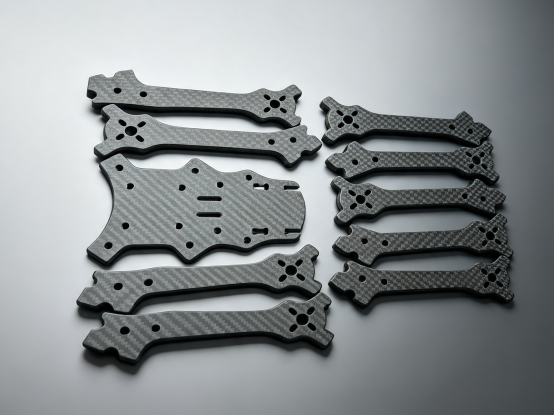
lDrone Arms. This is where carbon fiber sees the most mature application in UAVs. Carbon fiber tubes—round, square, or custom profiles—deliver both lightweighting and bending/torsional performance. In projects we've handled, switching to carbon fiber arms consistently yields substantial weight savings.
lFrames. Carbon fiber plates, either CNC-machined or compression-molded, provide equipment mounting bases and overall structural rigidity. Key considerations include stress distribution around cutouts and reinforcement at connection points.
lPayload Brackets. Supports for gimbals, cameras, and sensors benefit from carbon fiber's high stiffness and damping properties, reducing vibration interference with imaging and data collection.
lLanding Gear. Carbon fiber's high strength reduces weight contribution while handling impact loads during takeoff and landing.
Success with carbon fiber parts often comes down to details rather than material choice.
lLayup design. Drone arms experience both bending and torsion. We typically start with a load analysis, then propose layup schemes and material grading—high-strength fiber for load-bearing areas and standard-grade material for non-critical zones, maintaining performance while controlling cost.
lConnection points. Joints between arms and the fuselage or motors are where failures most often occur. Drilled edges are prone to delamination and fraying, so additional reinforcement around connection areas is essential. We recommend validating connection designs at the prototype stage rather than as an afterthought.
lCNC machining. Drilling and milling carbon fiber plates requires diamond-coated tools to control delamination and burrs. Most general machine shops aren't equipped for this—verify your supplier's machining capabilities.
lPrototype to production. Small batches can use CNC-machined plates and filament-wound tubes. For larger volumes, compression molding or blow molding is recommended for consistency. What works in prototyping often doesn't scale—draft angles, split lines, and curing cycles must be considered from the start.
GBTECH provides full-service support for UAV carbon fiber components, from design assistance to volume production. Our capabilities include filament winding, compression molding, autoclave processing, pultrusion, and CNC finishing—all under ISO 9001 quality management.
We recently completed an arm optimization project. The original injection-molded carbon fiber arm structure was replaced with a solution combining carbon fiber tubes and 3D-printed connectors. The weight of the arms has been significantly reduced, and the overall weight savings of the aircraft can be converted into extra battery capacity or payload, which directly translates into improved flight endurance. This case demonstrates that the value of carbon fiber lies not merely in material substitution, but more importantly in rethinking structural design.
If you're evaluating material solutions for UAV weight, stiffness, or endurance challenges, visit gbtechmaterials.com or reach out to our engineering team directly. Carbon fiber UAV components aren't "standard products"—every airframe has different load conditions, and each deserves a fresh approach starting from layup design. Bring your structural requirements, and we'll help you work out the solution.
Official GBTECH Websites:
EMail: zane@gbtechgroup.cn
Phone: +1 (510)902-9987
www.gbtechgroup.cn | www.gbtechcomposites.com | www.gbtechmaterials.com
US.Office: 38758 Buckboard Common, Fremont, CA 94536, United States
China Head Quaters: Building 1, Left Side, Tangye Road, Xinxu, Huiyang, Huizhou, China


 WhatsApp
 E-mail