When designing camera equipment structures, many challenges ultimately come down to two words: lightweight and stable.
Support arms that are too heavy cause fatigue during extended operation. Gimbal structures that are too heavy put extra strain on motors. Drone payloads that are too heavy eat into the weight budget reserved for cameras and batteries.
But weight reduction isn't the whole story.
A long support rod with insufficient rigidity can deform under the weight of the camera and lens. The deflection may be tiny — but for telephoto lenses, stabilizers, and precision optical equipment, even microscopic displacement can compromise image stability.
So the real challenge is: how do you reduce weight while preserving rigidity and stability?
This is exactly why carbon fiber deserves consideration.
Aluminum is easy to machine and a well-established material in camera equipment. But as structures get longer, devices become more portable, and systems pursue ever-lower overall weight, the inherent density of metal gradually becomes a limitation.
Carbon fiber composites offer high specific strength and specific stiffness. Simply put, they deliver excellent structural performance at a fraction of the weight.
Additionally, carbon fiber provides good vibration damping and corrosion resistance. For outdoor photography, aerial imaging, and long-term equipment use, these properties offer real-world value.
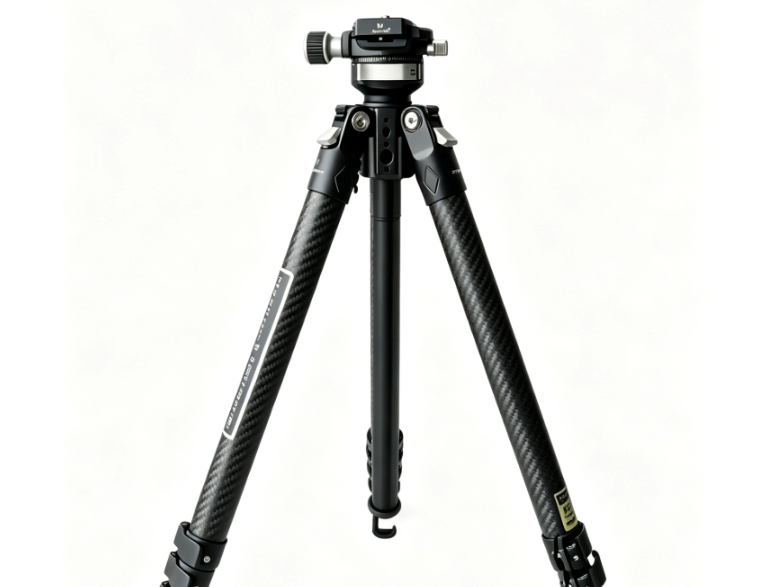
The most common application is support arms and extension rods.
These components are typically long and require sufficient rigidity. Carbon fiber tubes strike an excellent balance between weight and structural stability.
Next are gimbal arms and stabilizer components.
Gimbals are highly sensitive to moving mass. Lighter structural parts mean less mass for motors to control — making carbon fiber an ideal choice for weight- and rigidity-critical structures.
Tripods, monopods, and camera jib arms are also typical applications. They require long structural lengths while remaining easy to carry and quick to deploy.
Beyond these, camera rig cages, mounting plates, monitor brackets, and drone camera mounts can all benefit from carbon fiber sheets or custom carbon fiber tubes.
When planning custom parts, don't rush to specify materials.
Start by clarifying length, load, load direction, connection methods, and weight requirements. Is it a long-distance support or a frequently moving part? Is the primary load bending or torsion? These factors will determine the optimal tube diameter, wall thickness, and layup design.
For camera equipment, carbon fiber is not simply a "metal replacement" — it needs to be redesigned around the specific structure.
If you're developing camera support arms, gimbal components, jib arms, tripods, or drone mounting structures, you can provide drawings, dimensions, or application requirements. GBTECH can help select the right carbon fiber materials and structural solutions based on your specific use case, and support custom fabrication.
Learn more: https://gbtechmaterials.com/SendInquiry/
Official GBTECH Websites:
EMail: zane@gbtechgroup.cn
Phone: +1 (510)902-9987
www.gbtechgroup.cn | www.gbtechcomposites.com | www.gbtechmaterials.com
US.Office: 38758 Buckboard Common, Fremont, CA 94536, United States
China Head Quaters: Building 1, Left Side, Tangye Road, Xinxu, Huiyang, Huizhou, China


 WhatsApp
 E-mail