Industrial equipment is becoming faster, more precise in positioning, and lighter in structure. For automation equipment manufacturers and mechanical design engineers, material selection cannot be based solely on strength – weight, stiffness, vibration, and long-term stability must also be considered.
This is a key reason why carbon fiber sheets are increasingly used in industrial equipment. Compared to steel and aluminum, carbon fiber composites offer high stiffness at a lower weight, along with good fatigue resistance, corrosion resistance, and dimensional stability.
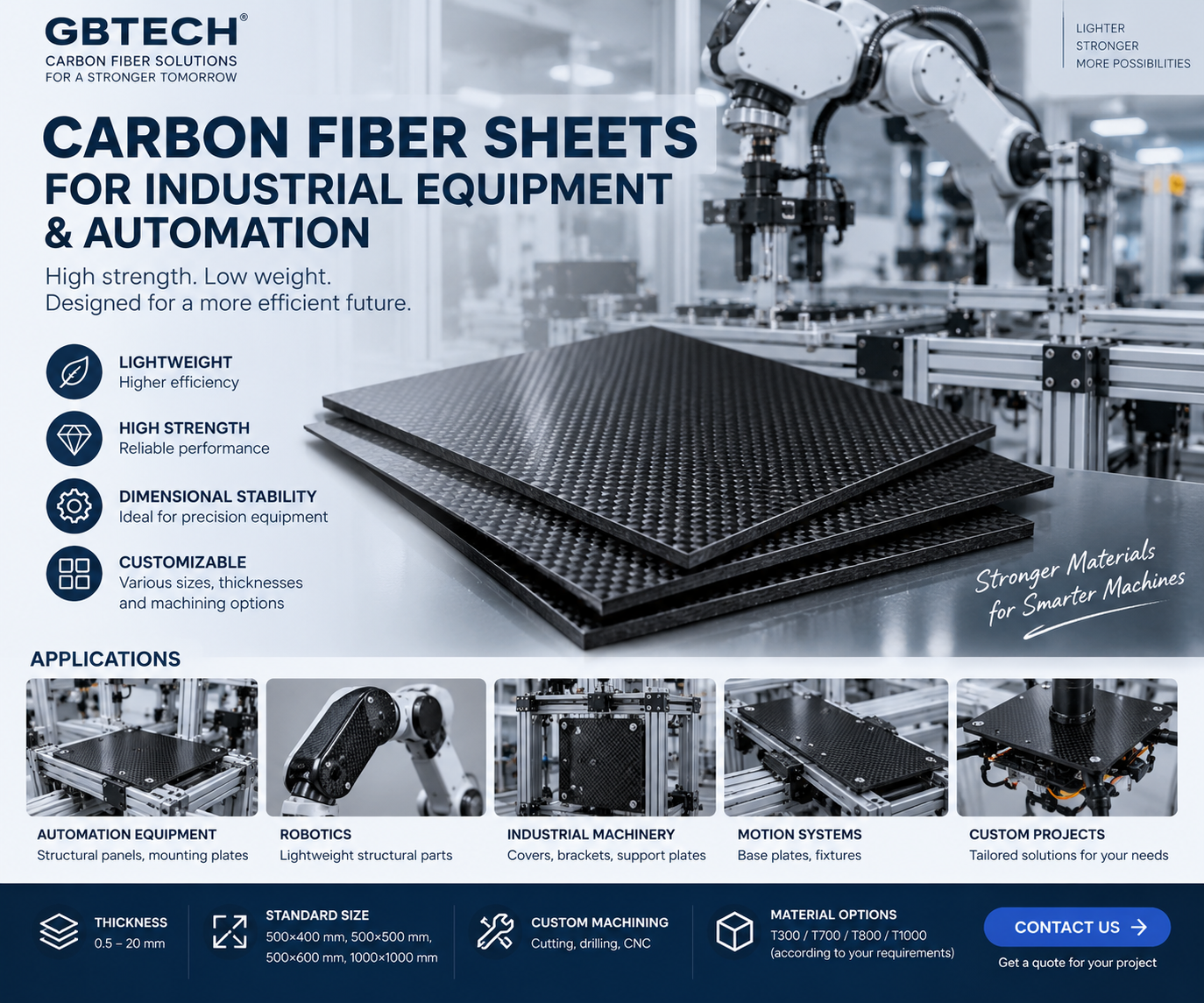
Why are industrial equipment manufacturers turning to carbon fiber sheets?
The most direct advantage is weight reduction. Carbon fiber composites typically have a density of approximately 1.6–2.0 g/cm³, which is significantly lower than other materials.
For robots and automation equipment, a lighter structure reduces the inertia of moving parts, which in turn lowers motor loads and enables faster acceleration and deceleration. In some industrial robot structures, replacing steel parts with carbon fiber can achieve substantial weight savings.
However, lightweighting is only one aspect. Carbon fiber also offers high specific stiffness and low thermal expansion, which are valuable for equipment that must maintain positioning accuracy.
Industrial robots and automation structural components
Robotic arms, joint connection plates, end-effector brackets, and mounting plates, support plates, and beams in automation equipment are common applications.
These components frequently accelerate, decelerate, and change direction. An excessively heavy structure places additional burden on the drive system.
Using carbon fiber helps maintain structural stiffness while reducing moving mass. By adjusting the fiber layup orientation in different directions, the material can be tailored to the actual loading conditions, making its properties more closely match the specific structure.
Precision equipment demands stability
For precision inspection equipment, sensor mounting platforms, and automated measurement systems, material weight is not the only consideration.
Vibrations generated during operation and dimensional changes caused by temperature fluctuations can both affect final accuracy. Carbon fiber composites have low thermal expansion and provide a degree of vibration damping, making them suitable for structural components that require high stiffness and dimensional stability.
Equipment panels and custom parts
Carbon fiber sheets are not limited to primary load-bearing structures.
Equipment panels, enclosures, protective covers, mounting bases, and various custom brackets can also be made from carbon fiber. For equipment that is frequently moved or disassembled, lower weight simplifies installation and maintenance. In humid or corrosive environments, carbon fiber also offers good corrosion resistance.
If your equipment has a unique structure, the material can be machined to specified dimensions and shapes based on drawings, for direct use in final assembly.
How to choose carbon fiber sheets?
For industrial equipment, selecting carbon fiber sheets cannot be based solely on thickness.
Sheet thickness, dimensions, fiber orientation, surface finish, and subsequent processing methods must all be determined in conjunction with the actual structure.
If post-machining is required, hole locations, contours, dimensional tolerances, and surface requirements should be confirmed in advance. Cutting, drilling, and CNC machining are all feasible, but different parts require different processing techniques.
From material substitution to structural optimization
Using carbon fiber in industrial equipment is not simply a matter of replacing aluminum or steel sheets with carbon fiber sheets. What truly matters is reducing unnecessary weight while meeting stiffness and strength requirements, enabling equipment to operate faster and more stably.
GBTECH can provide carbon fiber sheets for industrial equipment and supports custom sizing, cutting, drilling, and CNC machining. For different applications, the appropriate material and processing solution can be determined based on the usage scenario, dimensions, thickness, drawings, quantity, and performance requirements.
https://gbtechmaterials.com/SendInquiry/
https://gbtechmaterials.com/Carbon-Fiber-Sheets/
Official GBTECH Websites:
Email: zane@gbtechgroup.cn
Phone: +1 (510)902-9987
www.gbtechgroup.cn | www.gbtechcomposites.com | www.gbtechmaterials.com
US.Office: 38758 Buckboard Common, Fremont, CA 94536, United States
China Head Quaters: Building 1, Left Side, Tangye Road, Xinxu, Huiyang, Huizhou, China


 WhatsApp
 E-mail