An umbrella may look structurally simple, but designing reliable ribs and shafts places surprisingly high demands on the materials.
Umbrella ribs should not simply be made as stiff as possible. When exposed to wind, they need to support the canopy while also bending appropriately to release part of the load. If they are too flexible, the canopy may become unstable. If they are too stiff, loads may become concentrated around joints and connection points.
The umbrella shaft has a different role. It needs to remain as lightweight as possible while maintaining sufficient bending stiffness, straightness, and overall structural stability.
Rain, humidity, sunlight, temperature changes, and repeated opening and closing also mean that an umbrella is continuously exposed to both mechanical loading and outdoor environmental conditions.
This is one reason why more golf umbrellas, outdoor umbrellas, and lightweight umbrella products are beginning to consider carbon fiber umbrella ribs and carbon fiber shafts.
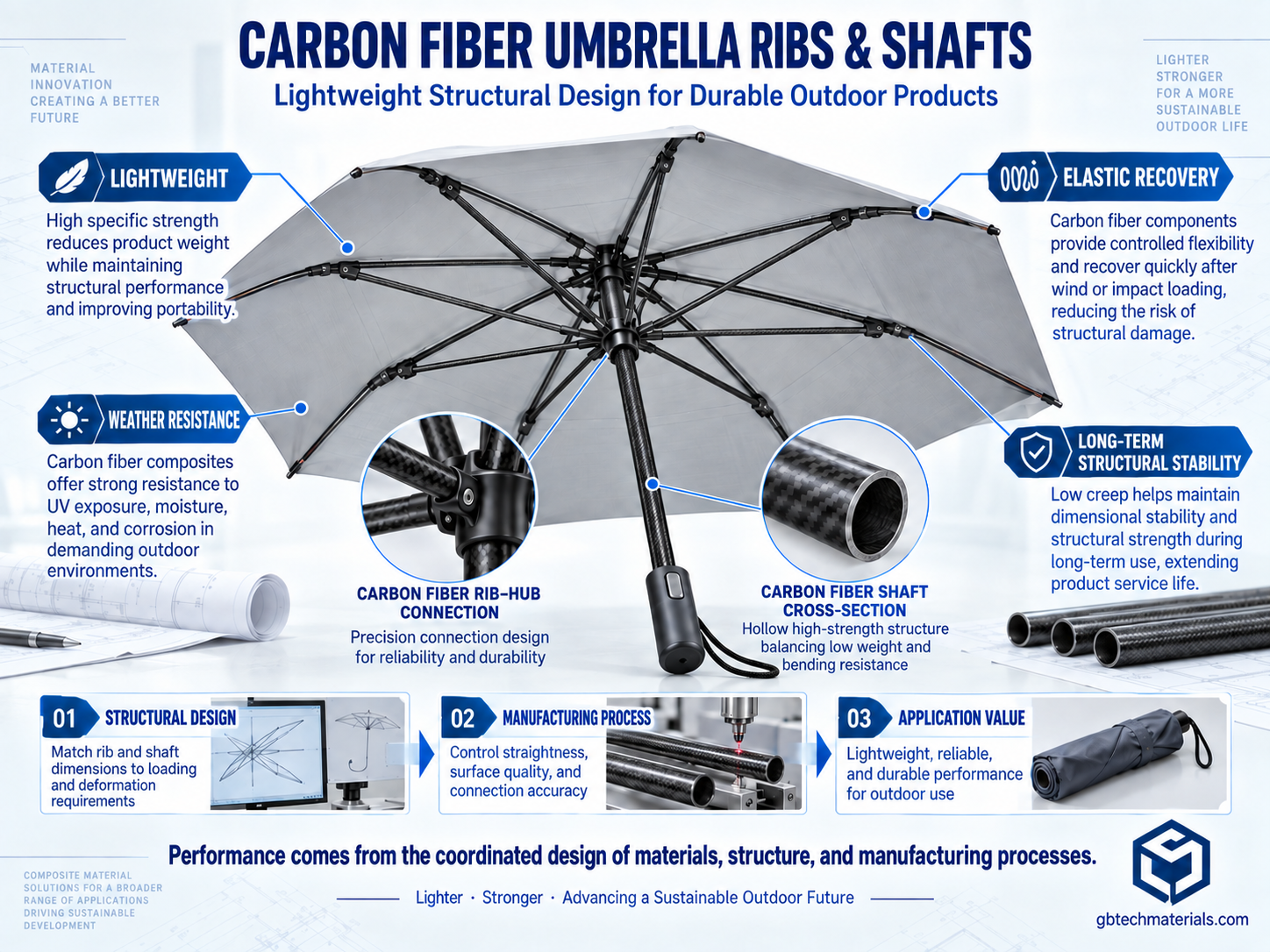
When designing umbrella ribs, one of the most important considerations is their bending response.
Carbon fiber has strongly directional mechanical properties, and this gives engineers more room to adjust performance through structural design.
Increasing the amount of fibers aligned along the length of the rib can improve longitudinal stiffness and load-bearing capability. Adding suitable off-axis fibers can help improve shear and torsional response.
This means that two carbon fiber umbrella ribs with the same length and diameter may still behave differently under bending simply because their internal layups are different.
So the design question should not only be, “What grade of carbon fiber should be used?”
It should also include questions such as:
How stiff does the rib need to be?
How much bending should be allowed under wind load?
Which areas are likely to experience the highest local loads?
The connection between the rib and other umbrella components often deserves even more attention than the middle section of the rib itself.
Where necessary, wall thickness, layup structure, or joint design may need to be adjusted to reduce local stress concentration.
The umbrella shaft provides the main structural support for the entire umbrella, so its design places greater emphasis on bending stiffness, straightness, and assembly stability.
The compatibility of the shaft with the handle, runner, top fittings, and other components also depends directly on tube outer diameter, dimensional tolerances, and surface quality.
For this reason, even when both the ribs and shaft use carbon fiber tubes, they should not automatically use the same structural design.
Compared with aluminum, carbon fiber can provide high specific stiffness at relatively low weight while avoiding the rust associated with conventional steel components.
Compared with fiberglass, carbon fiber is generally better suited to products with higher requirements for low weight and stiffness, while fiberglass often offers advantages in flexibility and cost.
There is no universally “best” material.
If cost is the main priority, carbon fiber may not always be necessary. But when the goal is to further reduce weight while maintaining stiffness, corrosion resistance, and long-term performance, carbon fiber provides greater design flexibility.
What the customer sees is a smooth carbon fiber tube.
What actually determines how that tube bends, how much load it can carry, and how stable it remains over time is the internal structure.
Fiber grade, fiber orientation, resin system, outer diameter, inner diameter, wall thickness, and taper all influence the final performance.
For outdoor applications, the long-term effects of ultraviolet exposure, humidity, and temperature changes on the resin system and surface also need to be considered. Appropriate surface protection may be required depending on the application environment.
Manufacturing quality is equally important.
For long, slender umbrella ribs and shafts, poor control of straightness, wall thickness consistency, or internal consolidation can affect both assembly accuracy and structural performance.
For this reason, when GBTECH develops custom carbon fiber umbrella ribs and shafts, the tube structure is selected according to target weight, flexibility, stiffness, length, diameter, taper, and connection method rather than simply producing a tube to a specified size.
If you are developing a rain umbrella, golf umbrella, sun umbrella, or another outdoor product, simply providing the required length and diameter is usually not enough.
It is better to provide an existing sample or drawing and explain the application scenario, the problem you want to improve, and the basic requirements for weight, flexibility, and appearance.
For components that must connect with handles, joints, runners, or other structural parts, the installation method and critical dimensions should also be confirmed in advance.
This allows the supplier to determine which parameters can remain unchanged and which parts may need to be redesigned specifically for carbon fiber.
If an existing sample or drawing is available, it can also be used directly as the starting point for development.
The more complete the information is at the beginning, the easier it becomes to define the material system, layup, and manufacturing process during the prototype stage and reduce repeated revisions later.
GBTECH can provide development and manufacturing support for carbon fiber umbrella ribs, shafts, and related custom components based on the umbrella structure and actual application requirements.
From tube specifications and structural design to prototyping and volume production, the goal is to translate the material advantages of carbon fiber into real performance in the finished product.
Submit custom requirements for carbon‑fiber umbrella components
View carbon‑fiber tubes and custom specifications
Official GBTECH Websites:
EMail: zane@gbtechgroup.cn
Phone: +1 (510)902-9987
www.gbtechgroup.cn | www.gbtechcomposites.com | www.gbtechmaterials.com
US.Office: 38758 Buckboard Common, Fremont, CA 94536, United States
China Head Quaters: Building 1, Left Side, Tangye Road, Xinxu, Huiyang, Huizhou, China


 WhatsApp
 E-mail