Why can two 60 g carbon fiber golf shafts feel completely different, with one providing more direct feedback and the other feeling smoother and softer?
The difference does not come only from the carbon fiber grade. Fiber layup, shaft taper, and weight distribution also play important roles.
One of the key advantages of carbon fiber is that the shaft structure can be engineered to suit different swing requirements.
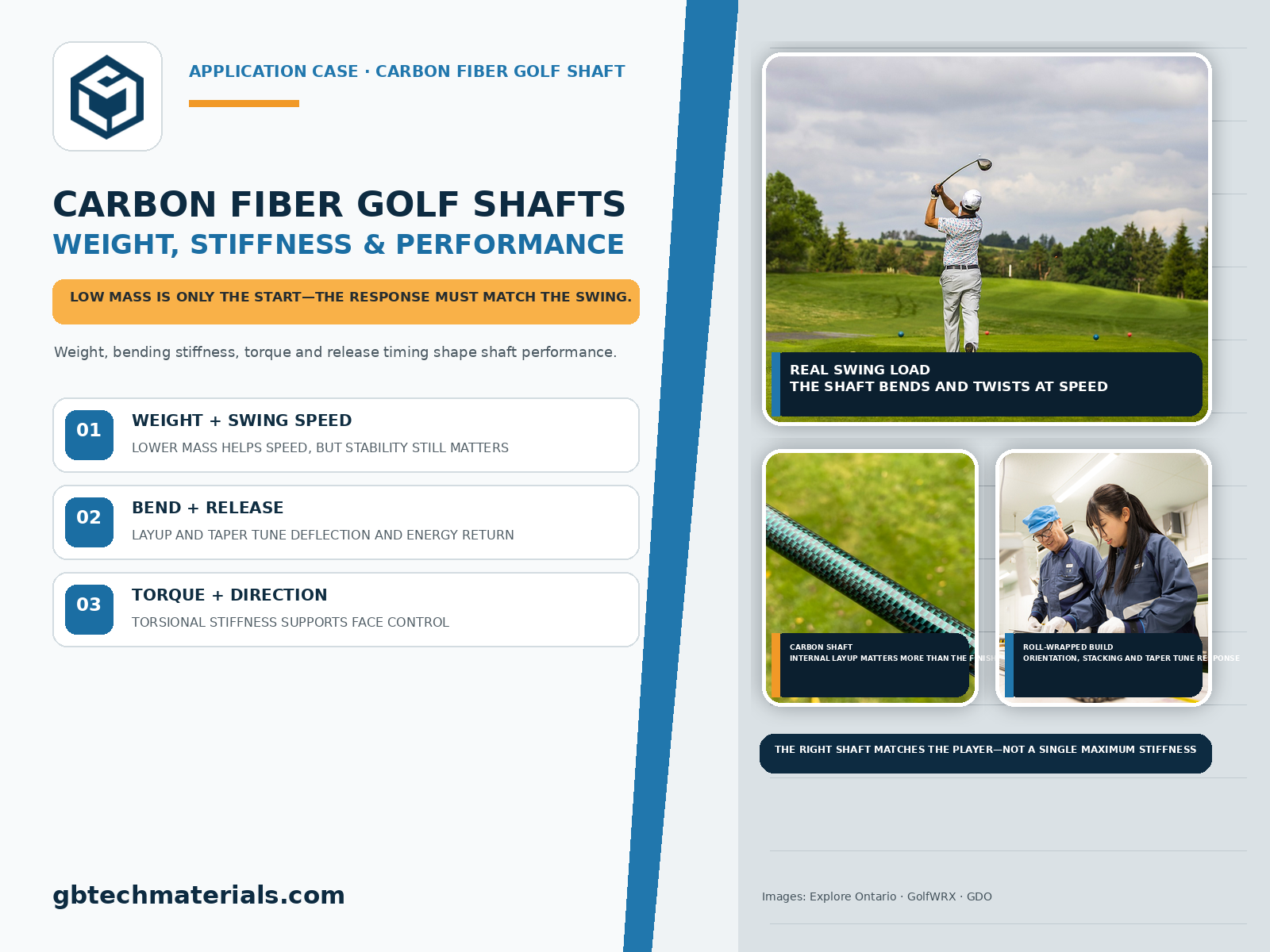
Shaft weight affects the overall balance of the club and the feel during the swing.
However, two shafts with the same weight do not necessarily perform in the same way.
During the swing, the shaft bends and twists. The amount of deformation and the way the shaft recovers both influence its dynamic response.
Different structural designs can therefore create different swing rhythms and feel, even when overall shaft weight is similar.
For example, two 60 g shafts can be designed with different bending characteristics simply by adjusting local wall thickness and fiber configuration.
So shaft selection should not be based only on weight and flex rating. Actual playing requirements also need to be considered.
One of the main advantages of carbon fiber is its design flexibility.
By changing fiber orientation and where individual layers are placed, engineers can tune the shaft according to different loading requirements.
Axial plies mainly influence bending behavior.
Off-axis plies help control torsional deformation.
Circumferential plies can improve transverse stability of the tube wall.
Local layup design is also important.
For example, adjusting the fiber configuration near the grip section, mid-section, or tip section can change the shaft’s bending profile and recovery response.
Taper and wall thickness also influence weight distribution along the shaft.
This means that even when the same carbon fiber grade is used, shafts with very different performance characteristics can still be developed.
Different golfers have different swing speeds, loading patterns, and feel preferences, so suitable shaft configurations will also vary.
For example, 50 g, 60 g, and 70 g shaft categories can support different weight requirements.
But a lighter shaft does not automatically mean a faster swing, and a stiffer shaft does not necessarily mean more accurate shots.
For products designed for faster response, the shaft’s bending profile and weight distribution may deserve more attention.
For products where torsional deformation needs to be controlled, torsional stiffness should also be evaluated.
Actual shaft selection should also consider clubhead weight, club length, and overall balance.
It should not be based only on the flex designation printed on the shaft.
From material selection to finished product, shaft performance is influenced by fiber grade, resin system, laminate structure, and manufacturing quality.
For example, fiber grades such as T700 and T800 do not directly determine the final performance of the shaft.
A suitable material combination and manufacturing process are often more important than simply using a higher-grade fiber.
For custom projects, it is useful to confirm the following in advance:
lShaft length
lButt and tip diameters
lTarget weight
lBending characteristics
lTorsional requirements
lSurface finish
lPurchase quantity
This information makes it easier to evaluate the appropriate material and manufacturing solution.
GBTECH can provide carbon fiber material selection, tubular composite structure development, and custom processing support based on golf shaft dimensions, performance targets, and manufacturing requirements, helping customers identify a suitable production solution.
Send Inquiry:https://gbtechmaterials.com/SendInquiry/
View Carbon Fiber tube Specifications:https://gbtechmaterials.com/Carbon-Fiber-Tubes/
Official GBTECH Websites:
EMail: zane@gbtechgroup.cn
Phone: +1 (510)902-9987
www.gbtechgroup.cn | www.gbtechcomposites.com | www.gbtechmaterials.com
US.Office: 38758 Buckboard Common, Fremont, CA 94536, United States
China Head Quaters: Building 1, Left Side, Tangye Road, Xinxu, Huiyang, Huizhou, China


 WhatsApp
 E-mail