Carbon fiber is increasingly finding its way into CNC machinery and industrial automation. The material's strength-to-weight ratio and vibration damping properties make it attractive for components like gantry beams, robotic arms, and spindle supports. But carbon fiber is not metal—and designing with it requires a fundamentally different approach.
A common mistake is treating carbon fiber as a direct drop-in replacement for aluminum or steel. That thinking leads to project delays, cost overruns, or field failures. Here is a real example of how one customer learned this firsthand—and how GBTECH helped them get it right.
An automation equipment manufacturer approached GBTECH with a straightforward request: replace an existing aluminum CNC component with a carbon fiber version. The aluminum part was heavy—limiting the machine's speed and energy efficiency. The target was simple: reduce weight while maintaining the same precision and strength.
What seemed like a simple substitution turned out to be anything but.
The customer had already tried other suppliers who quoted "drop-in replacements" without asking about load paths, operating temperatures, or assembly methods. Several prototypes were made—and all failed in testing. The issue wasn't the material itself. The issue was how it was being used.
The customer's repeated failures came down to several key issues:
Carbon fiber is anisotropic—its strength depends entirely on fiber orientation and layup. The customer's original design was optimized for isotropic aluminum, so the fiber orientation was wrong from the start. Material selection was also problematic. The customer assumed T700 was always better than T300, but many non-structural areas would have been fine with T300—blindly chasing higher grades only added cost. On the manufacturing side, prototypes used soft tooling that allowed zero draft angles and undercuts, but production steel tooling requires proper draft and split lines. What works for a prototype mold doesn't necessarily work for production. Surface finish was another issue—prototypes could be hand-sanded to meet requirements, but that approach is neither economical nor consistent at volume. Finally, carbon fiber CNC machining requires specialized tooling and dust control. Most general machine shops are not equipped to handle this material properly.
None of these issues were catastrophic on their own, but together, they brought the project to a standstill.
When GBTECH's engineering team took over, they tackled every issue systematically.
First, they conducted a full structural analysis and reassessed the load paths. T700 with directional layup was used for load-bearing areas, while T300 was applied to non-critical regions. This preserved performance while keeping material costs under control. Proper draft angles and split-line designs were established to ensure the production molds would release parts cleanly. Surface finish was planned around repeatable processes, minimizing hand finishing. The entire production run was completed in-house at GBTECH—from layup and curing to CNC finishing—with every step controlled under ISO 9001 procedures.
GBTECH also reviewed the customer's assembly method. Drilling and joining carbon fiber is fundamentally different from working with aluminum, and the layup around connection points required additional reinforcement. Without someone flagging these details, they are easy to overlook.
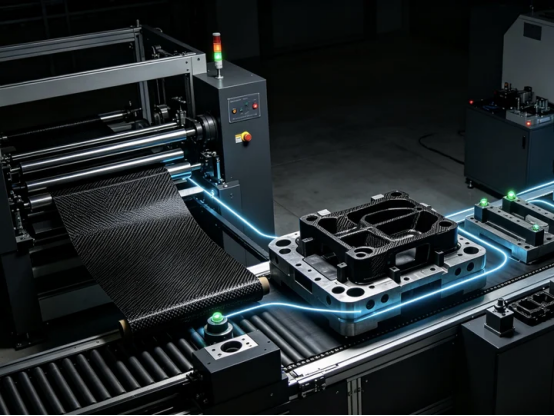
With full engineering support from GBTECH, the project moved forward with positive outcomes:
lThe carbon fiber component achieved significant weight reduction compared to the original aluminum part.
lStrength and stiffness largely met the design requirements.
lThe connection solution passed testing, and the prototype validation went smoothly.
lThe component transitioned to volume production and was delivered on schedule.
The customer was satisfied with the results and has since listed GBTECH as a preferred supplier for their carbon fiber components.
This case illustrates the most common pitfalls when moving from metal to carbon fiber: treating carbon fiber as a metal substitute, defaulting to the highest fiber grade, ignoring production design early, assuming prototype success scales directly, and using general machining for composite materials.
GBTECH is more than a carbon fiber manufacturer. They are an engineering partner that provides full-service support—from design assistance and prototype development to mass production—with capabilities including autoclave, filament winding, pultrusion, RTM, and CNC finishing, all under ISO 9001 quality management.
Whether you are in the US, Russia, or elsewhere, the question is the same: do you need a supplier who only takes orders, or a partner who will challenge your assumptions and improve your design?
Contact GBTECH to discuss your next carbon fiber CNC component project.
Official GBTECH Websites:
EMail: zane@gbtechgroup.cn
Phone: +1 (510)902-9987
www.gbtechgroup.cn | www.gbtechcomposites.com | www.gbtechmaterials.com
US.Office: 38758 Buckboard Common, Fremont, CA 94536, United States
China Head Quaters: Building 1, Left Side, Tangye Road, Xinxu, Huiyang, Huizhou, China


 WhatsApp
 E-mail