With more than 20 years of experience in composite materials engineering, I have found that many engineers and purchasing professionals face a terminology question before they even get to material performance: What is the difference between Carbon Fiber Sheet and Carbon Fiber Plate?
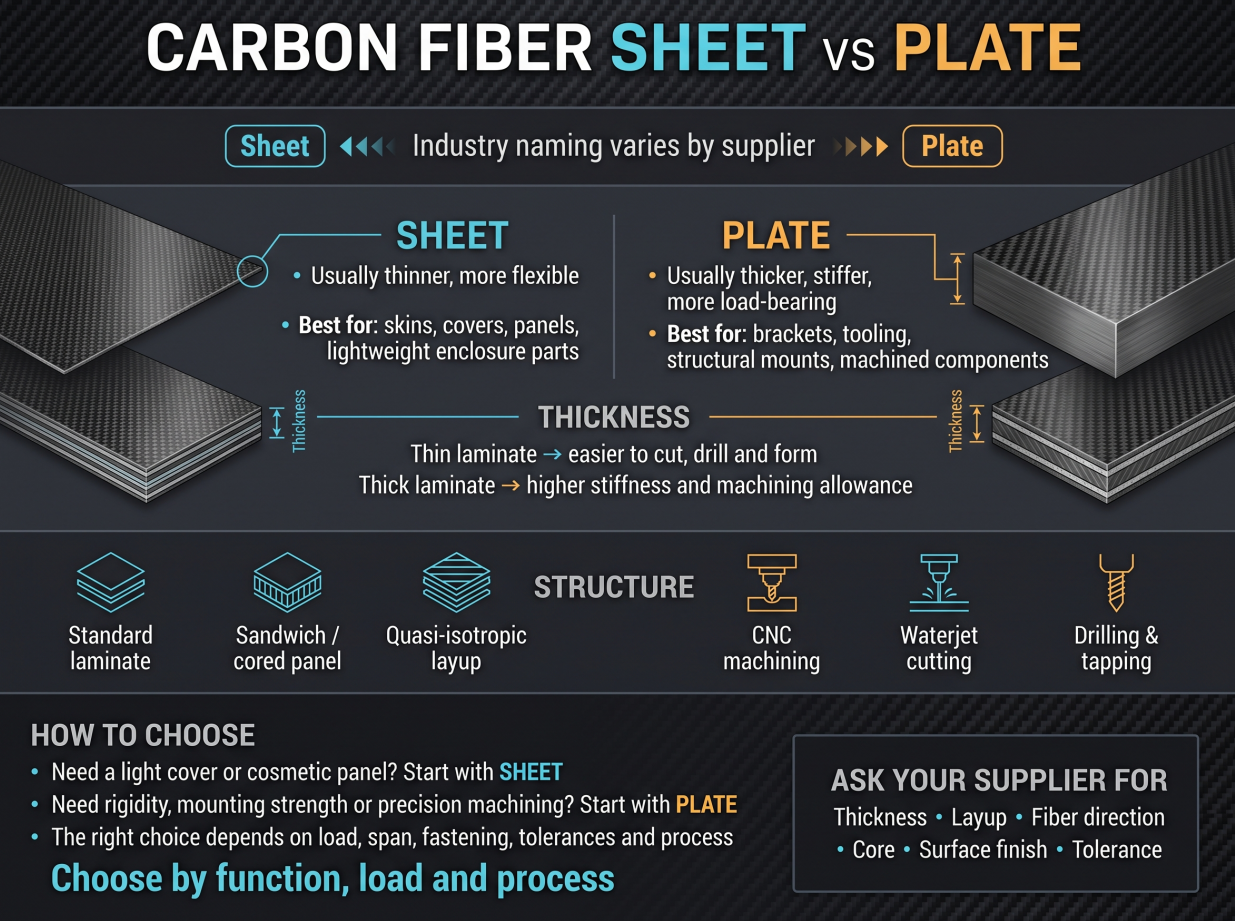
In the industry, Sheet and Plate are often differentiated by thickness. Many suppliers refer to products around 3 mm or thinner as Sheet, while products thicker than 3 mm are often called Plate. However, this is not a universally standardized international definition. Different suppliers and application fields may use these terms differently.
Therefore, the more important question is not whether a product should be called Sheet or Plate, but rather: How thick does the project actually need to be, what level of stiffness is required, and what type of processing will be needed?
From a practical perspective, carbon fiber Sheet is generally thinner and lighter, making it suitable for products where weight and available space are important considerations. Applications may include equipment covers, electronic components, UAV structures, thin exterior parts, and various prototype components.
Thicker carbon fiber Plate, on the other hand, generally provides higher overall stiffness and is more suitable for robot base plates, equipment mounting plates, mechanical structural components, and other applications requiring greater structural stability.
However, thickness is not the only factor determining performance. Carbon fiber sheets with the same thickness can have different strength and stiffness depending on the fiber type, laminate orientation, and resin system.
For actual engineering projects, I recommend evaluating the material based on structural requirements rather than focusing too much on the product name.
Comparison | Carbon Fiber Sheet | Carbon Fiber Plate |
Typical Thickness | Approx. 0.5–3 mm | Typically over 3 mm |
Main Advantage | Lightweight and thin | Higher stiffness |
Typical Applications | Covers, exterior parts, thin structures | Mounting plates, supports, structural components |
Common Processing | Cutting, drilling | CNC machining, drilling, milling |
Purchasing Focus | Weight, thickness, surface finish | Stiffness, load capacity, machining accuracy |
If the main goal is lightweight construction and the application does not require very high structural stiffness, a thinner Sheet is often sufficient.
If the product needs to withstand higher loads or must maintain minimal deformation during operation, a thicker Plate may be more appropriate.
Simply put: prioritize Sheet when lightweight design is the main goal, and consider Plate when structural stiffness is the priority.
Carbon fiber sheets and plates are not always ready to use immediately after purchase. For many engineering projects, the material needs to be cut, drilled, or machined into a complex profile.
Thinner sheets can usually be processed with standard cutting and drilling methods for simple applications. For thicker carbon fiber Plate requiring precise hole locations, slots, steps, or complex contours, CNC machining is generally a more suitable solution.
GBTECH supplies carbon fiber Sheet and Plate in different thicknesses and also supports custom cutting and precision CNC machining. For projects that require the material to be processed directly into finished components, this one-stop approach can reduce the time and effort required to coordinate multiple suppliers.
The first mistake is assuming that thicker is always better.
Increasing thickness can improve stiffness, but it also increases weight, material cost, and processing costs. The right choice is the thickness that meets the actual requirements of the application.
The second mistake is comparing material prices only.
A lower material price does not necessarily mean better overall value. Purchasing decisions should also consider material specifications, actual usage, processing requirements, and project needs. Selecting the right sheet specification is often more important than simply choosing the lowest price.
The third mistake is looking only at thickness without considering the laminate structure.
Carbon fiber is an anisotropic composite material. Fiber type, fiber orientation, and resin system all affect final performance. For structural components, simply comparing “3 mm versus 5 mm” is not enough to determine which material is more suitable.
Carbon Fiber Sheet and Carbon Fiber Plate are not simply two completely different materials. They are more accurately different product forms used for different thickness and structural requirements.
Based on more than 20 years of engineering experience, I recommend focusing on the factors that actually affect project performance: load, stiffness, weight, processing, and cost, rather than focusing solely on terminology.
GBTECH supplies carbon fiber sheets and plates in different thicknesses and supports custom dimensions, cutting, and CNC machining. If you already have a specific project, you can send your drawings, dimensions, load requirements, and quantity to the GBTECH technical team for a free material selection recommendation.
www.gbtechmaterials.com
marketing@gbtechgroup.cn
Official GBTECH Websites:
EMail: zane@gbtechgroup.cn
Phone: +1 (510)902-9987
www.gbtechgroup.cn | www.gbtechcomposites.com | www.gbtechmaterials.com
US.Office: 38758 Buckboard Common, Fremont, CA 94536, United States
China Head Quaters: Building 1, Left Side, Tangye Road, Xinxu, Huiyang, Huizhou, China


 WhatsApp
 E-mail