When people think about carbon fiber reinforcement for concrete structures, carbon fiber fabric is often the first material that comes to mind.
But in real engineering projects, carbon fiber reinforcement is available in several different forms.
Depending on the material form, installation location, and load-transfer mechanism, common solutions include carbon fiber fabric, carbon fiber plates, CFRP rebars, and carbon fiber grids.
All four belong to the broader carbon fiber reinforcement family, but they are designed to solve different problems.
The real question during material selection is not simply “Which one is stronger?”
Instead, you need to ask:
Where will the material be installed? What structural problem needs to be solved? And which form is suitable for the available construction conditions?
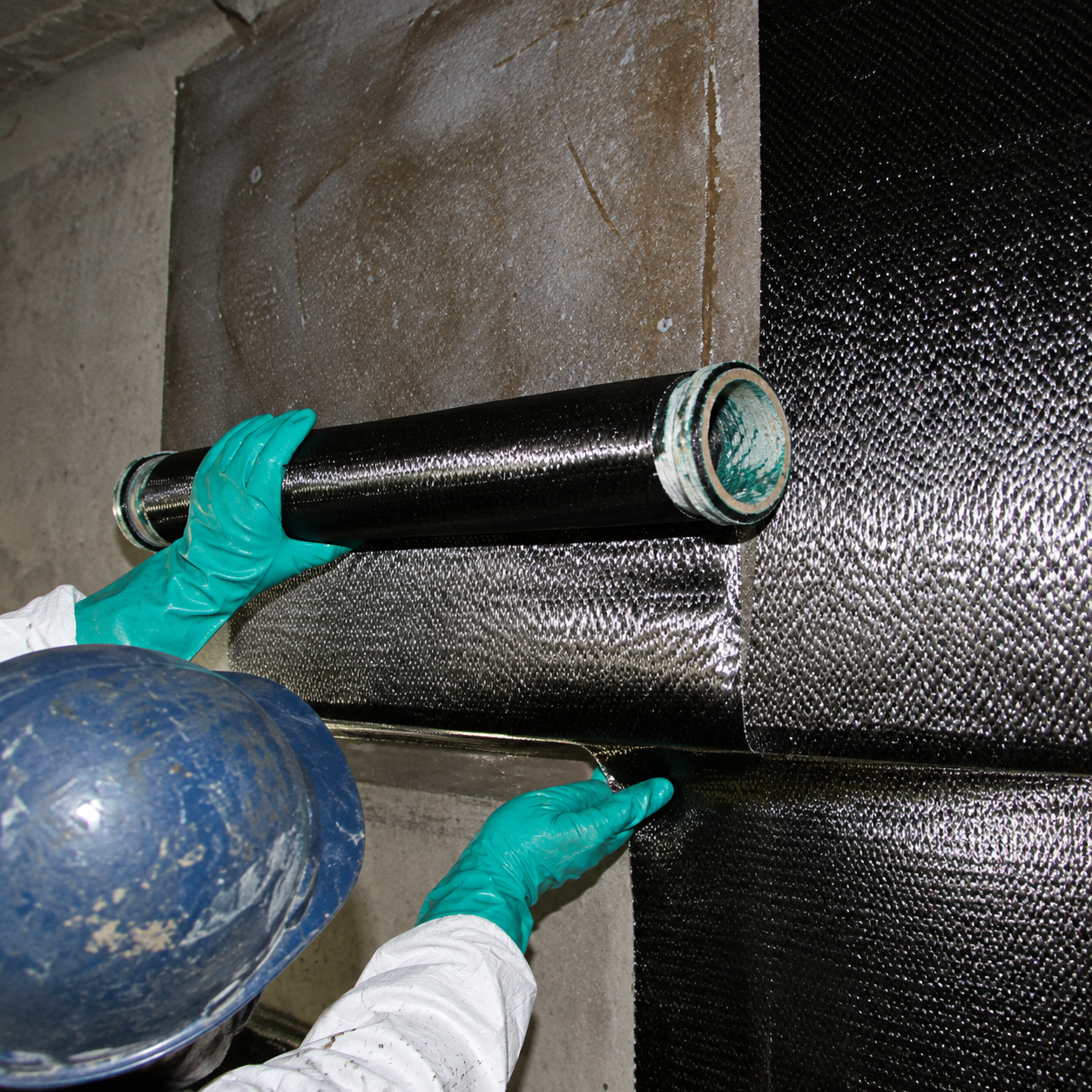
The main advantage of carbon fiber fabric is its flexibility.
It can conform to columns, beam sides, joints, curved surfaces, and other irregular structural elements.
In strengthening existing concrete structures, it is commonly used for circumferential column wrapping, beam-end shear strengthening, local confinement, and reinforcement of irregular areas.
The fibers can also be oriented according to the primary load direction, giving the material strong installation flexibility.
However, carbon fiber fabric does not achieve its full strength simply by being bonded to the structure.
It relies on resin impregnation and bonding to form an integrated composite strengthening layer.
The condition of the substrate, fiber orientation, lap details, resin impregnation, wrinkles, and voids can all affect final performance.
So the main advantage of carbon fiber fabric is flexibility, while its actual performance depends heavily on proper design and installation quality.
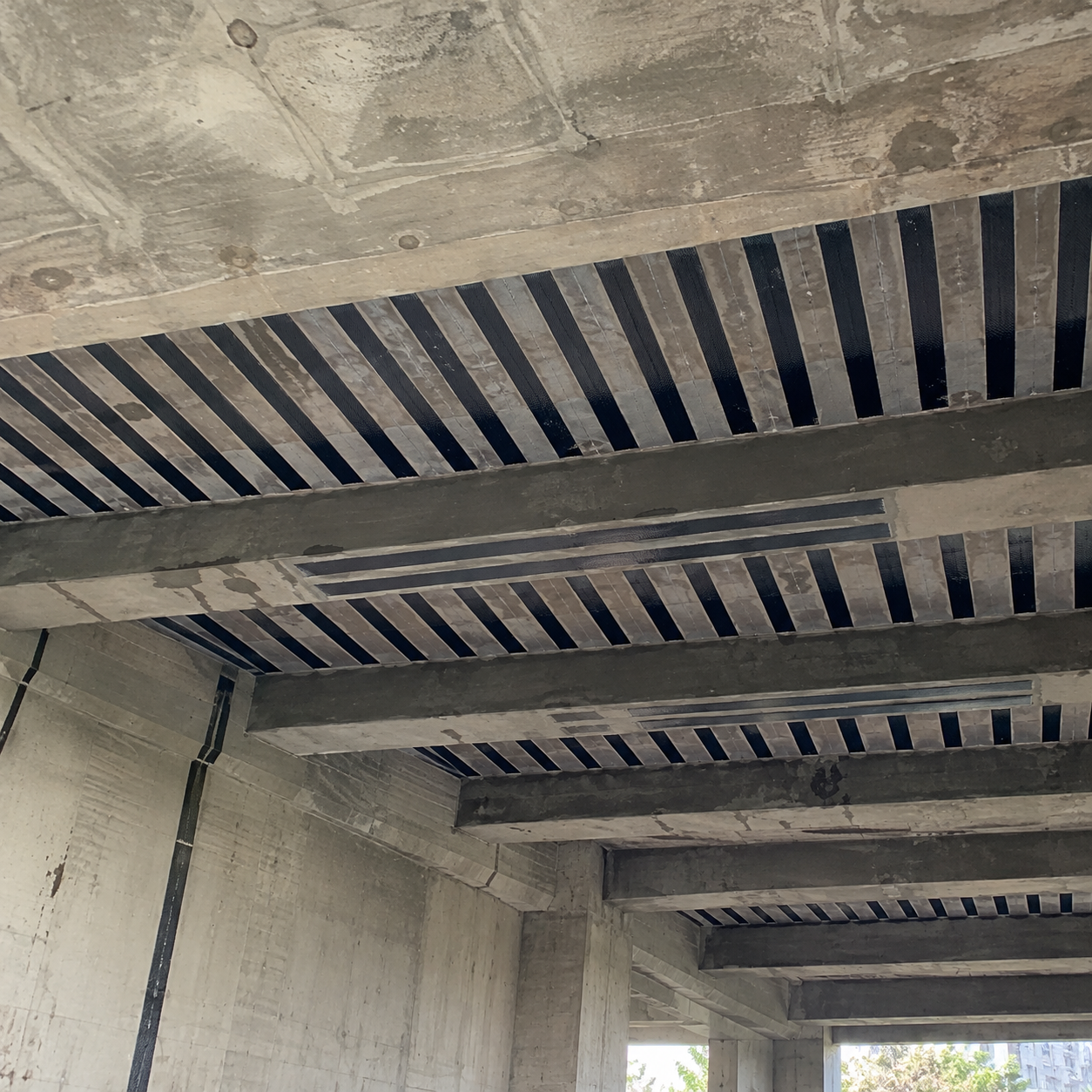
Carbon fiber plates are typically manufactured with continuous fibers aligned mainly along the length of the plate, providing stable axial tensile properties and relatively high stiffness.
This makes them particularly suitable for flexural strengthening in tension zones such as the underside of beams and slabs.
For structural members with regular surfaces and clearly defined load directions, the plates can be installed directly along the primary tensile direction.
However, carbon fiber plates place higher demands on substrate flatness and bond quality.
In addition to the strength of the plate itself, engineers need to consider end stresses, bond length, and whether loads can be effectively transferred from the existing concrete into the plate.
If the bonding interface fails first, even a very strong carbon fiber plate cannot fully utilize its material properties.
Therefore, carbon fiber plates are especially suitable for efficient directional reinforcement of regular structural members.
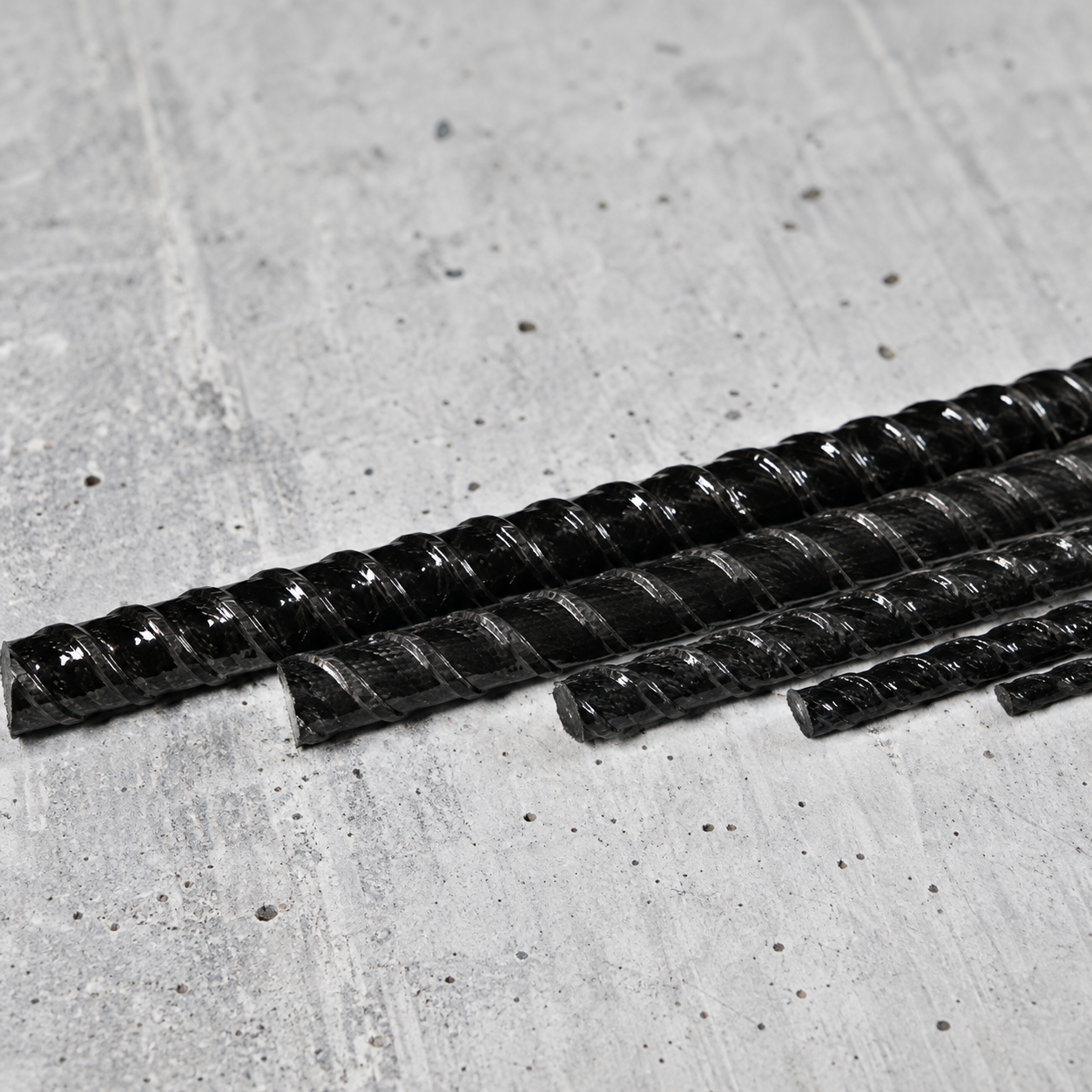
CFRP rebar works very differently from carbon fiber fabric and plates.
It is usually installed inside concrete for new construction or precast components rather than bonded to the surface of an existing structure.
Its main advantages include corrosion resistance, low weight, and non-magnetic behavior.
This gives CFRP rebar potential value in marine environments, chemical facilities, magnetically sensitive areas, and projects where long-term steel reinforcement corrosion is a concern.
However, it should not simply be treated as “steel rebar that does not rust.”
Its elastic modulus, bond behavior, failure characteristics, and on-site handling methods are different from those of steel reinforcement.
Design therefore needs to follow the corresponding principles for composite reinforcement rather than replacing steel bars one-for-one based only on size.
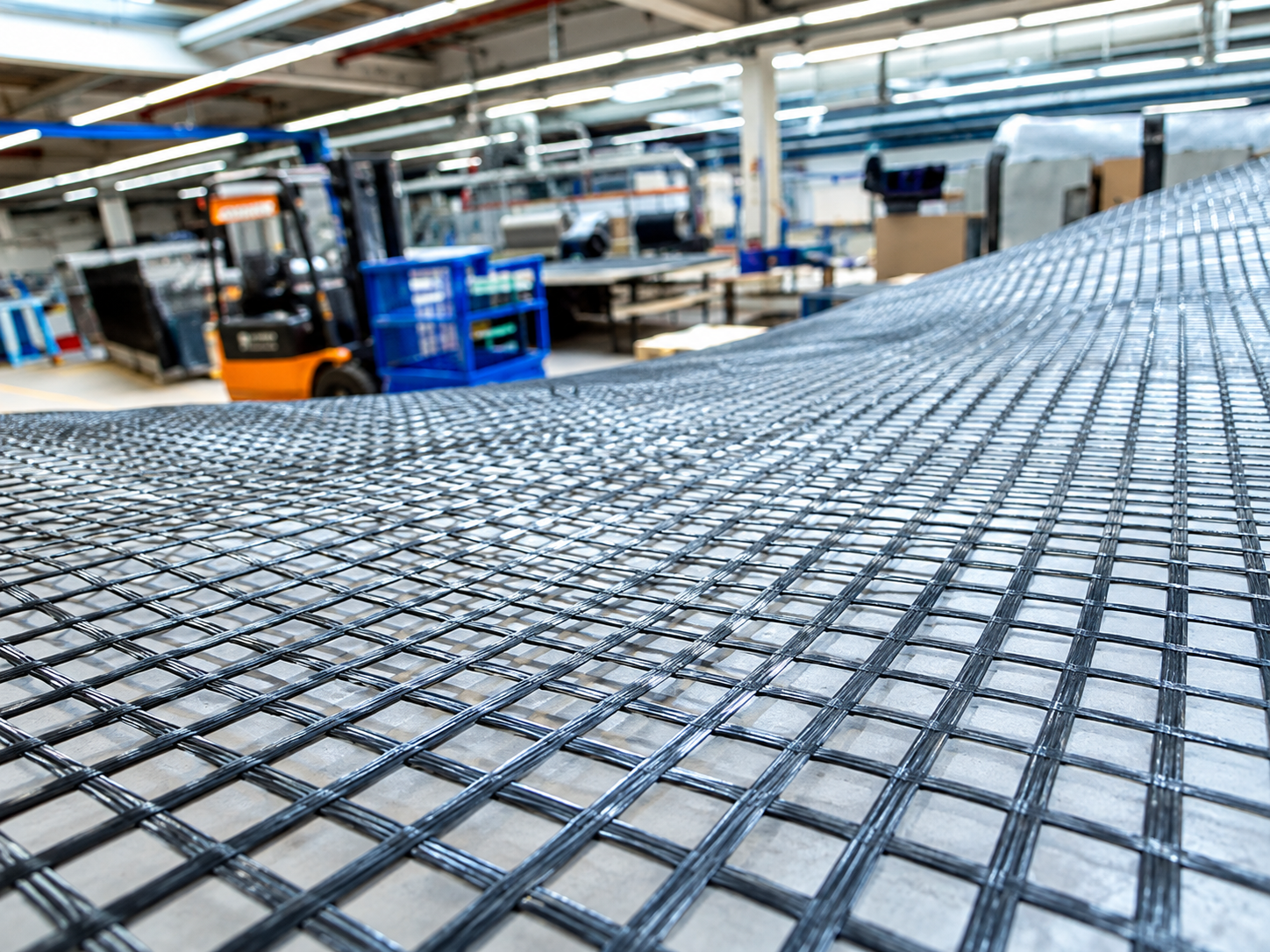
Carbon fiber grids are typically formed from fiber bundles arranged in two or more directions, allowing distributed reinforcement over a relatively large area.
They can be used in thin slabs, precast components, bridge decks, wall panels, and localized reinforced structures.
Compared with individual CFRP rebars, grids are better suited to large-area and multi-directional reinforcement.
Compared with externally bonded carbon fiber fabric, they are generally more suited to being integrated within the structure or working together with newly cast material.
However, grid spacing, fiber orientation, joint configuration, and the bond between the grid and concrete all influence actual structural performance.
Therefore, a carbon fiber grid should not simply be viewed as a “lightweight version of steel reinforcing mesh.”
Start with the installation location.
If an existing beam, slab, column, or similar member needs strengthening, carbon fiber fabric or carbon fiber plates are usually considered first.
If reinforcement is being incorporated inside a new, precast, or reconstructed concrete element, CFRP rebar or carbon fiber grids may be considered.
Then look at the geometry and loading condition.
For complex surfaces, wrapping, and shear strengthening, carbon fiber fabric is usually more suitable.
For regular, flat members with a clearly defined tensile direction, carbon fiber plates are often more appropriate.
For linear internal reinforcement, CFRP rebar may be considered.
For large-area, multi-directional internal reinforcement, carbon fiber grids may be evaluated.
This approach is more meaningful than simply comparing material strength.
Before selecting the material, several basic questions should be clarified:
Is the structure new or existing?
Will the carbon fiber reinforcement be placed inside or outside the concrete?
Is the main objective flexural strengthening, shear strengthening, confinement, corrosion resistance, or something else?
Is the structural geometry regular or complex?
Which design codes and standards apply to the project?
Once these questions are clear, the range of suitable materials usually becomes much narrower.
If you are evaluating carbon fiber reinforcement for a concrete structure, you can provide GBTECH with the member type, installation location, main structural issue, dimensions, environmental conditions, and project requirements.
Based on the actual application, carbon fiber fabric, carbon fiber plates, CFRP rebar, or carbon fiber grids can then be matched to the project requirements.
Send Inquiry:https://gbtechmaterials.com/SendInquiry/
View Carbon Fiber Sheet Specifications:https://gbtechmaterials.com/Carbon-Fiber-Sheets/
View Carbon Fiber Fabric Specifications:https://gbtechmaterials.com/carbon-fiber-fabric/
Official GBTECH Websites:
EMail: zane@gbtechgroup.cn
Phone: +1 (510)902-9987
www.gbtechgroup.cn | www.gbtechcomposites.com | www.gbtechmaterials.com
US.Office: 38758 Buckboard Common, Fremont, CA 94536, United States
China Head Quaters: Building 1, Left Side, Tangye Road, Xinxu, Huiyang, Huizhou, China


 WhatsApp
 E-mail