With the rapid advancement of new material technologies, carbon fiber composites have emerged as a preferred choice in industries such as aerospace, automotive manufacturing, and high-end equipment. Combining lightweight characteristics with exceptional strength, this “black gold” of modern industry is reshaping the trajectory of multiple sectors.
Let’s explore the full picture—from core properties to real-world applications—and unlock the true value of carbon fiber composites.
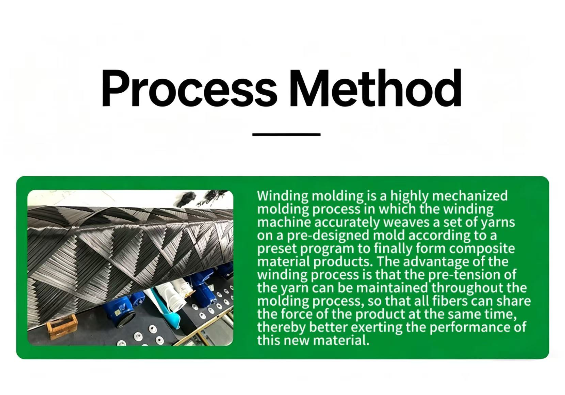
To produce high-performance carbon fiber composite products, advanced forming technology is essential. Among various methods, the filament winding process stands out for its high precision and efficiency.
Filament winding is a highly automated process in which fibers are wound onto a pre-designed mold using programmed patterns. During the entire forming process, consistent fiber tension is maintained, ensuring uniform load distribution across all fibers.
This allows the material properties of carbon fiber to be fully utilized, significantly enhancing the structural stability and durability of the final product.
Carbon fiber composites stand out due to their eight irreplaceable core properties, each aligned with the demands of high-end manufacturing:
1. Low Density and Lightweight
With a density approximately 1/5 of copper and 3/5 of aluminum alloy, carbon fiber significantly reduces overall product weight. This is especially valuable in applications such as drone components and lightweight automotive parts, improving endurance and efficiency.
2. Excellent Chemical Corrosion Resistance
It effectively replaces metals in corrosive environments, extending product lifespan. Ideal for chemical equipment and marine engineering applications.
3. Fatigue Resistance and Long Service Life
Carbon fiber does not undergo permanent deformation under repeated stress, ensuring high safety, stability, and minimal performance degradation over time.
4. High Strength and High Modulus
Its strength is about 1.3 times that of copper and 3.7 times that of aluminum alloy, greatly improving mechanical performance such as rigidity and load-bearing capacity.
5. Low Thermal Expansion Coefficient
Maintains structural stability under temperature fluctuations, making it suitable for rail transportation and outdoor equipment.
6. Good Electrical Conductivity
Offers reliable conductivity in composite structures, suitable for electronic devices and anti-static applications.
7. Energy Absorption and Vibration Damping
Effectively reduces vibration and noise, improving comfort and operational stability in applications like automotive chassis and precision instruments.
8. Self-Lubrication and Wear Resistance
Its self-lubricating properties reduce friction and wear, enabling long-term stable operation with minimal maintenance.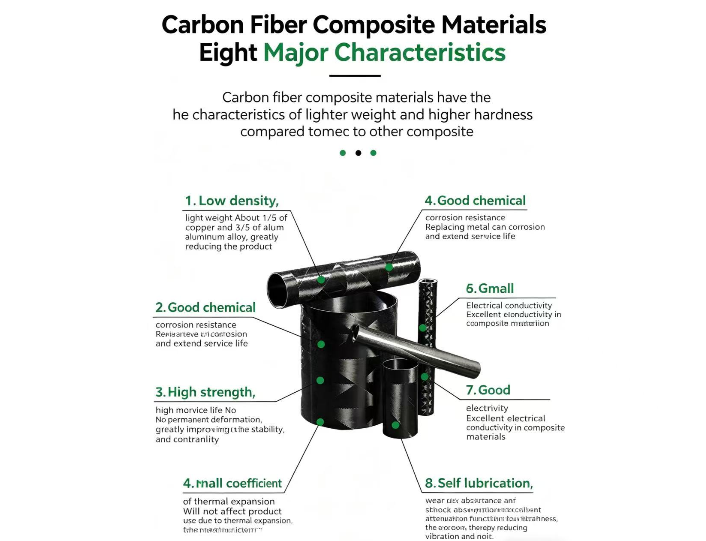
High-quality carbon fiber composite products rely on strict control across the entire production chain.
As a specialized manufacturer and supplier of carbon fiber products, we are committed to:
Direct factory supply with consistent quality assurance
A comprehensive product portfolio supporting customized solutions
Strict production standards, from raw material selection to final inspection
A fast delivery system and responsive after-sales support
This ensures reliable performance and a seamless customer experience from production to delivery.
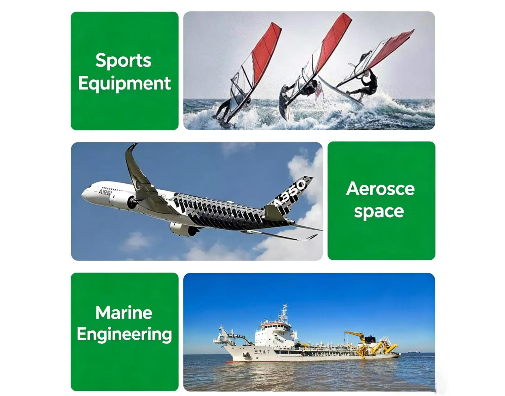
Thanks to their outstanding properties, carbon fiber composites are widely used across six major sectors:

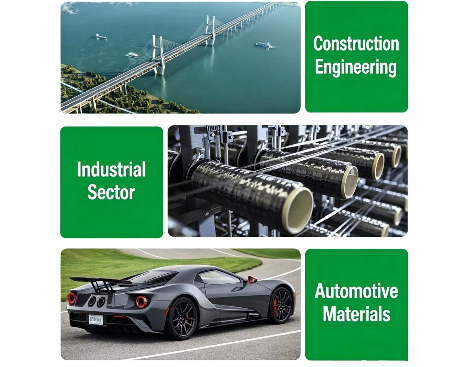
1. Construction Engineering
Used in structural reinforcement and architectural decoration for bridges and high-rise buildings, improving durability while reducing structural load.
2. Industrial Applications
Applied in chemical equipment, industrial robots, and transmission systems, offering corrosion resistance, wear resistance, and high rigidity.
3. Automotive Materials
A key material for lightweight modification and high-end vehicle manufacturing, used in body structures, chassis, and interior components to enhance performance and fuel efficiency.
4. Sports and Recreation
Widely used in badminton rackets, golf clubs, bicycle frames, and drone arms, delivering superior performance through lightweight strength.
5. Rail Transportation
Used in train body structures and interior components to reduce weight, increase speed, improve energy efficiency, and minimize noise and vibration.
6. Low-Altitude Aircraft
Essential for drones and light aircraft, ensuring structural stability, extended flight endurance, and adaptability for aerial photography, surveying, and reconnaissance.
From the precision of the filament winding process to its eight core performance advantages, carbon fiber composites have become a key driver of industrial upgrading and technological innovation.
As a source manufacturer, we remain committed to quality and integrity, continuously advancing the development and application of carbon fiber composites.
With ongoing technological breakthroughs, this advanced material will continue to expand its applications and play an even greater role in driving high-quality development across industries.
Official GBTECH Websites:
EMail: zane@gbtechgroup.cn
Phone: +1 (510)902-9987
www.gbtechgroup.cn | www.gbtechcomposites.com | www.gbtechmaterials.com
US.Office: 38758 Buckboard Common, Fremont, CA 94536, United States
China Head Quaters: Building 1, Left Side, Tangye Road, Xinxu, Huiyang, Huizhou, China


 WhatsApp
 E-mail