“Can a metal part simply be reproduced in carbon fiber using the same dimensions?” This is one of the most common questions in carbon fiber replacement projects.
Some parts can retain most of their original dimensions, but for components that genuinely carry structural loads, directly copying the metal design is usually not recommended. Once the material changes, the original design logic may no longer be appropriate.
Metal generally has relatively uniform mechanical properties, while carbon fiber performance depends heavily on fiber orientation, layup design, and manufacturing method. Wall thicknesses, holes, threads, and connection features that work well in metal may not perform the same way in carbon fiber. In some cases, copying them directly not only limits the potential weight savings but can also create weak areas around holes, joints, or between laminate layers.
For this reason, the first question when integrating carbon fiber should not be simply “Can this part be made?” but rather “Why was the original part designed this way?”
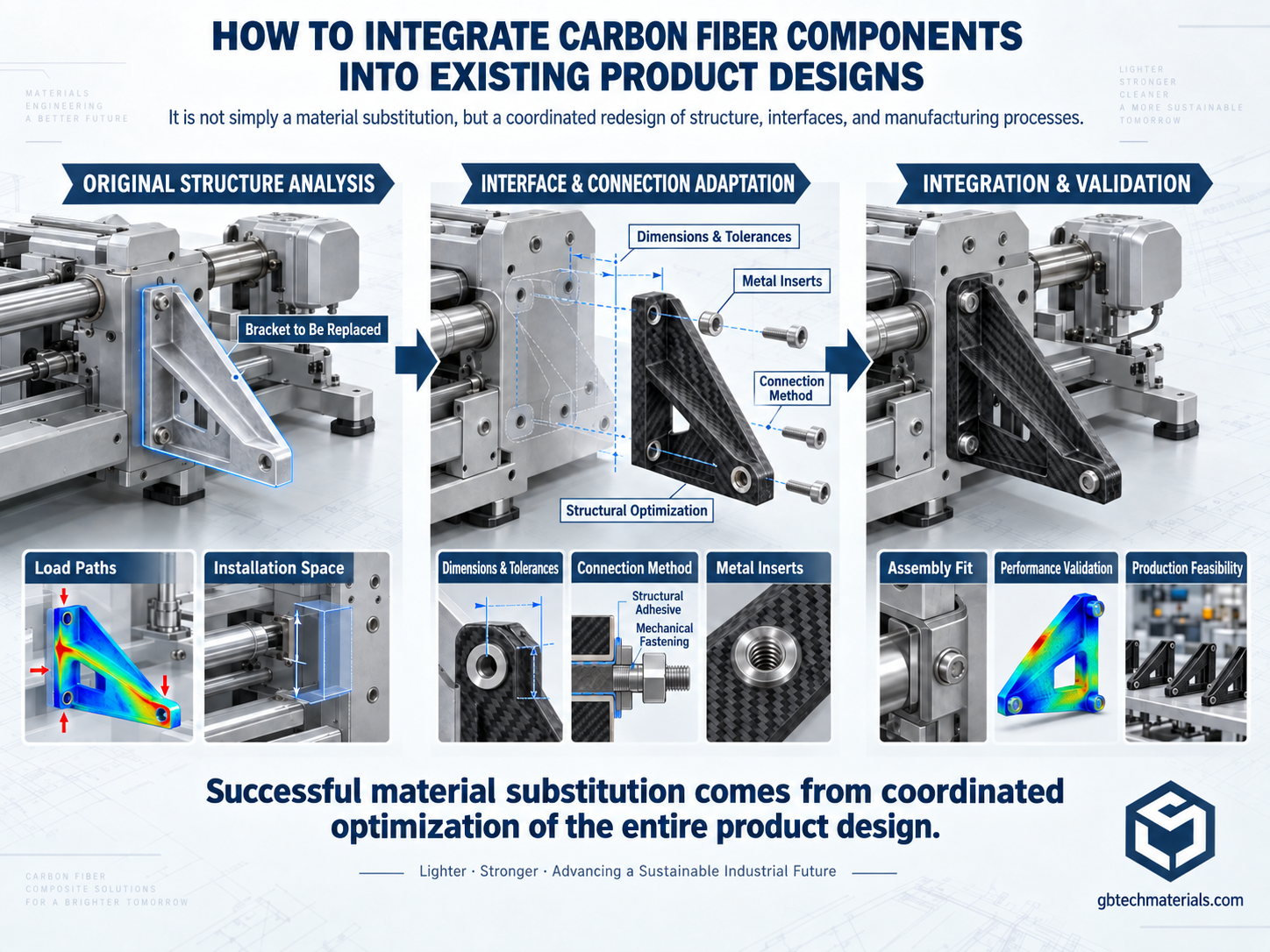
When reviewing an existing part drawing, dimensions are only the first layer of information. More important is understanding the role of the component within the complete assembly.
Is it mainly subjected to bending, tension and compression, or torsion? Where does the load enter the part, and where is it transferred? Which areas are truly load-bearing, and which features exist mainly for installation or assembly?
Only after these questions are understood does it make sense to define a carbon fiber solution.
For example, the thickness of a metal support may have been determined by the stiffness of the metal itself and by the manufacturing process used to produce it. After switching to carbon fiber, maintaining the same thickness may not be necessary.
Instead, the layup can be redesigned around the primary loading directions. More fibers can be placed in critical load paths, while unnecessary material can be reduced in less important areas.
This is where carbon fiber replacement creates real value — not by copying the original structure, but by redistributing performance according to the material’s characteristics.
Carbon fiber components rarely work in isolation. They usually need to connect with metal brackets, bearings, housings, motors, or other parts within an assembly.
For that reason, hole positions, tolerances, mounting surfaces, and connection methods should all be considered during the design stage.
Take a bolt hole as an example. A standard hole in a metal component becomes more complex when transferred into a carbon fiber structure. Cutting a hole interrupts the fibers, which can change local load-bearing capability and may introduce risks such as bearing failure, delamination, or local crushing.
In higher-load areas, it may be necessary to add local reinforcement, increase the bearing area, or use metal inserts rather than simply duplicating the original hole geometry.
There is also no single connection method that works for every project.
If disassembly is required, bolts or inserts may be suitable. If reducing drilled holes is a priority, adhesive bonding may be a better option. For carbon fiber tubes connected to end fittings, sleeve joints, adhesive bonding, or clamping can be selected depending on the loading conditions.
When carbon fiber is in long-term contact with metals such as aluminum, electrical isolation may also be necessary depending on the service environment to reduce the risk of galvanic corrosion in humid conditions.
These details may appear minor, but they often determine whether a replacement design is reliable in practice.
Another issue that is often underestimated is that manufacturing must be considered early in the design process.
Different carbon fiber geometries, layups, production volumes, and surface requirements are suited to different manufacturing methods. Compression molding, autoclave processing, filament winding, and pultrusion each have their own advantages and limitations.
A structure that works well for a low-volume prototype may become difficult or expensive to manufacture at scale. Tooling costs, machining steps, cycle time, and production consistency can all become important factors.
For this reason, it is more practical to divide the project into several stages.
First, define the main upgrade goals, such as weight reduction, stiffness improvement, or corrosion resistance. Then analyze the existing structure and interfaces.
After selecting the material system, layup, and connection strategy, produce a prototype and verify it through assembly and load testing. The structure and manufacturing process can then be adjusted based on the results.
If the shape of a metal part is simply copied in carbon fiber, the result may only be a “carbon fiber version” of the original component — not necessarily a better product.
Effective integration means preserving the existing interfaces and assembly relationships where practical, while reconsidering thickness, layup, local reinforcement, hole design, inserts, and manufacturing methods.
The goal is to find the right balance between performance, weight, cost, and manufacturing feasibility.
So, when upgrading an existing product, it is helpful to provide more than just the original part drawing.
Information such as the application, loading conditions, installation relationships, weight or stiffness targets, service environment, surface requirements, and expected production volume can all significantly improve the quality of the carbon fiber design evaluation.
GBTECH can use this information to help assess carbon fiber replacement options and provide project support from material and structural design coordination to prototype development, custom manufacturing, and volume production.
View Carbon Fiber Sheet Specifications
View Carbon Fiber Tube Specifications
Official GBTECH Websites:
EMail: zane@gbtechgroup.cn
Phone: +1 (510)902-9987
www.gbtechgroup.cn | www.gbtechcomposites.com | www.gbtechmaterials.com
US.Office: 38758 Buckboard Common, Fremont, CA 94536, United States
China Head Quaters: Building 1, Left Side, Tangye Road, Xinxu, Huiyang, Huizhou, China


 WhatsApp
 E-mail