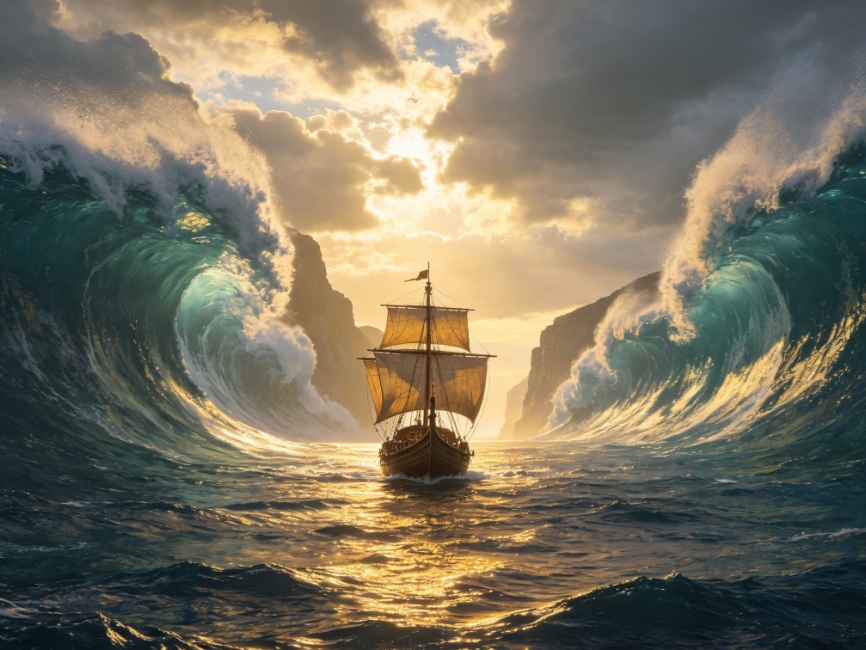
Odysseus’s homeward journey was a decade-long war with the sea. In Homer’s epic, the hero spent ten years battling storms, reefs, sea monsters, and the wrath of gods—and his enemies—wave impact, salt-spray erosion, hull fatigue—are precisely the same obstacles that every modern vessel and underwater robot must overcome. If Odysseus could have chosen his hull material, his journey might have taken ten weeks, not ten years.
Today, the maritime industry is staging its own “Odyssey.” Unmanned surface vessels, deep-sea explorers, offshore wind platforms, and polar research ships sail into seas far more remote than any epic, undertaking missions far more demanding than any legend. And their guardian is no longer Athena’s divine power, but carbon fiber composites.
Storm: Corrosion—The First Trial of Marine Engineering
Odysseus’s greatest misfortune came from Poseidon’s fury, but the ocean’s attack on materials is far more persistent and insidious than divine wrath. Chloride ions in seawater penetrate metal grain boundaries, triggering stress corrosion cracking. Marine biofouling alters surface flow characteristics, accelerating localized corrosion. Diurnal temperature swings and tidal cycles subject metals to thermal expansion and contraction, accumulating microscopic cracks.
While conventional marine steel offers reliable strength, it demands sacrificial anodes, periodic coating maintenance, and frequent non-destructive testing in marine environments. According to U.S. Naval Research Laboratory data, corrosion-related maintenance accounts for over 30% of a destroyer’s total lifecycle maintenance budget. Carbon fiber composites are fundamentally different—the polymer matrix encapsulates the reinforcing fibers, forming an impermeable barrier that prevents seawater from contacting the fibers, resulting in zero electrochemical corrosion. This is one reason why GBTECH’s filament-wound carbon fiber tubes are favored in marine projects: their epoxy resin system and fiber interface are optimized to withstand over 2,000 hours of salt-spray testing without performance degradation.
Drift: Fatigue—The Invisible Killer of Deep-Sea Navigation
Odysseus drifted for ten years; his hull endured countless storm impacts, reef scrapes, and grounding repairs. For modern vessels and marine robots, this “cyclic loading” has a professional term—fatigue. Waves pound a hull once per second—86,400 times a day, over 30 million times a year. Under alternating stress, metals develop microscopic slip bands that grow into macroscopic cracks, ultimately leading to brittle fracture—a process almost undetectable through visual inspection.
Carbon fiber composites exhibit near-perfect fatigue resistance. Their fatigue limit can reach 60%-80% of static strength, far exceeding steel’s 30%-50%. More critically, composite damage is progressive—from matrix microcracks to delamination growth to fiber rupture—and the strain signal changes throughout this process can be monitored in real time, providing early warning for structural health monitoring. Marine robotics developers increasingly use carbon fiber for thruster brackets, robotic arm joints, and pressure-hull support frames—components subject to continuous vibration and alternating loads. GBTECH’s precision carbon fiber tubes, manufactured with high-modulus fibers and optimized layup designs, retain over 90% of their initial stiffness after 10⁷ cyclic loading cycles, delivering material assurance that “ten years of drifting” won’t compromise structural integrity.
Homecoming: Lightweighting—The Shortest Path to the Destination
Odysseus finally reached Ithaca, but his return was detoured across much of the Mediterranean because of ship damage. Had his vessel been lighter, more agile, and faster, he might have avoided many calamities. In marine engineering, lightweighting means the same: greater efficiency, longer range, and lower costs.
The shipping industry has a “millennium rule”: every 10% reduction in hull weight yields approximately 5%-7% higher speed or 6%-8% lower fuel consumption. For unmanned systems, the multiplier effect is even more dramatic—a lighter hull reduces propulsion system size, shrinks battery capacity, and increases payload space, creating a positive feedback loop. Carbon fiber composites have a density of just 1.5-1.6 g/cm³, with specific strength 10-20 times that of steel. This means carbon fiber structural components are over 70% lighter than steel at equivalent strength.
The America’s Cup 75-foot foiling monohulls are the ultimate proof of this logic—constructed entirely of carbon fiber, they weigh less than a quarter of a steel vessel of the same dimensions, yet achieve speeds exceeding 50 knots under wind power. This performance gap has awakened the global marine engineering community to a new reality: carbon fiber is no longer an “elite material”—it is “the right material.” GBTECH brings this “rightness” to more marine equipment manufacturers through global supply chains and custom fabrication—whether USV skeletons, ROV chassis, or offshore wind platform structural supports, their carbon fiber plates and tubes deliver higher design freedom at lower weight.
Epilogue
Odysseus’s epic ended, but humanity’s contest with the sea never ceases. Today’s “Odyssey” is no longer the legend of one man and one ship—it is the maritime industry’s relentless pursuit of materials that are lighter, stronger, and more durable. Carbon fiber composites are the answer to this “modern Odyssey.” And GBTECH, with its precision manufacturing capabilities and global supply network, is providing the “material oars” for this voyage—ensuring that every vessel and every robot, like Odysseus, can cross storms, round reefs, and finally reach its own Ithaca.
Official GBTECH Websites:
EMail: zane@gbtechgroup.cn
Phone: +1 (510)902-9987
www.gbtechgroup.cn | www.gbtechcomposites.com | www.gbtechmaterials.com
US.Office: 38758 Buckboard Common, Fremont, CA 94536, United States
China Head Quaters: Building 1, Left Side, Tangye Road, Xinxu, Huiyang, Huizhou, China


 WhatsApp
 E-mail