“I need a carbon fiber tube—something lightweight and strong.”
For a supplier, however, this description is usually not enough. Without clear dimensions, tolerances, material requirements, and application details, the project may require multiple rounds of clarification, slowing down both quotation and delivery. In some cases, the final product may not meet the requirements of the intended assembly.
If you need a custom carbon fiber tube, preparing the key specifications in advance helps the supplier understand your requirements faster and provide a more accurate quotation.
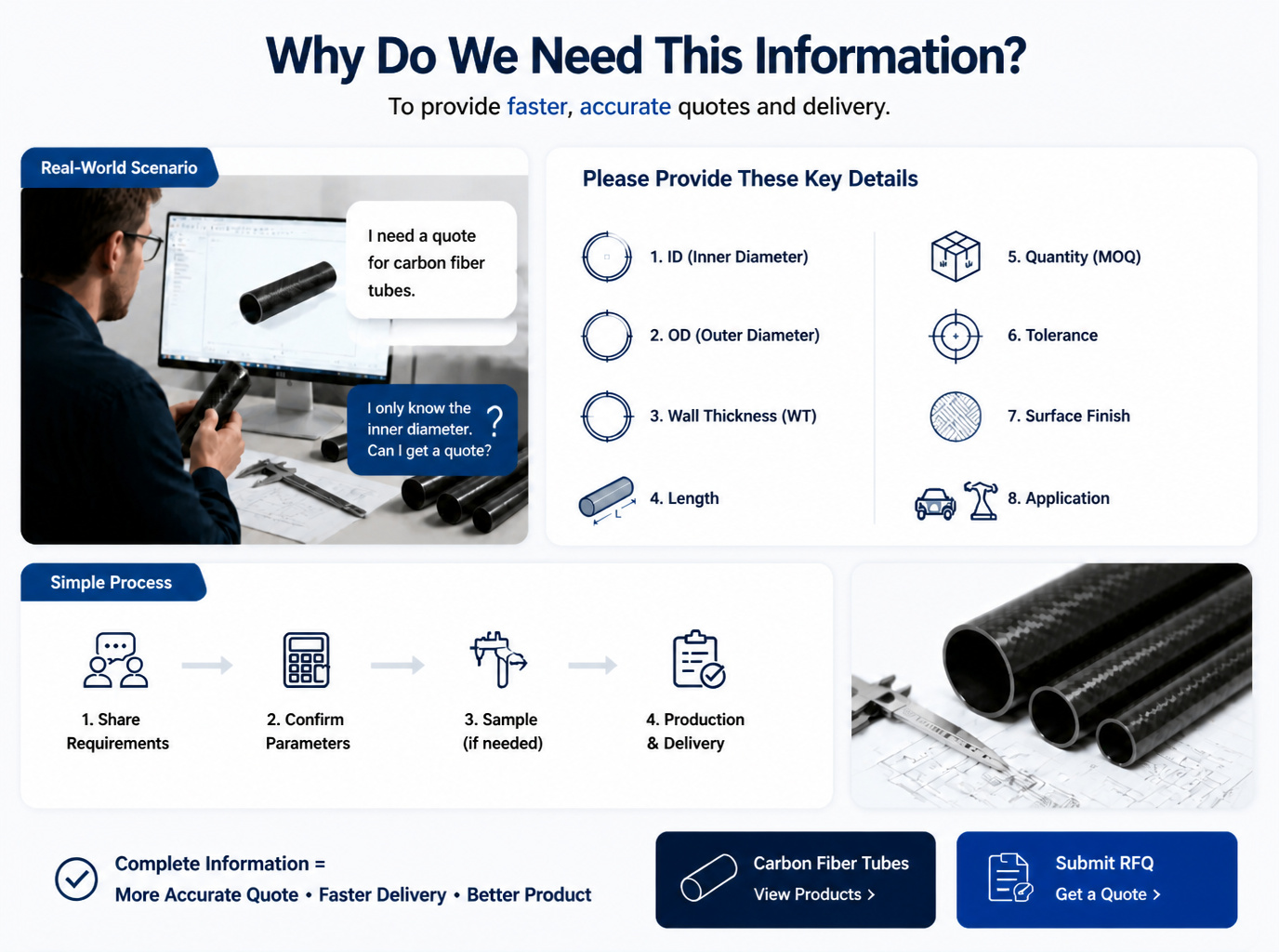
Outer Diameter (OD): The outside diameter of the tube, usually measured with a caliper or micrometer. It determines how the tube fits with external components such as brackets, bearings, and connectors. Typical tolerances may be specified according to the application, such as ±0.05 mm or ±0.1 mm.
Inner Diameter (ID): The diameter of the hollow section inside the tube. It can be measured with an internal micrometer or plug gauge. If the OD and wall thickness are known, the ID can be calculated using: ID = OD − 2 × Wall Thickness.
Wall Thickness: Wall thickness directly affects the tube’s strength, stiffness, weight, and cost. However, thicker does not always mean better. The appropriate thickness should be selected based on the load, tube diameter, load direction, and available installation space.
Length: The overall axial length of the tube. In addition to the length itself, specify the required length tolerance and whether end-face finishing, chamfering, drilling, or slotting is required.
If you already have a complete design drawing, providing a 2D or 3D drawing is usually the most efficient option. The drawing should clearly show the ID, OD, wall thickness, length, and tolerances.
If you only know some of the dimensions, you can calculate the others based on the information available. For example:
Known ID: 10 mm, wall thickness: 1.5 mm:
OD = 10 + 1.5 × 2 = 13 mm
Known OD: 20 mm, wall thickness: 2 mm:
ID = 20 − 2 × 2 = 16 mm
If the dimensions are not yet defined, you do not need to guess. Provide GBTECH with the equipment type, expected load, installation space, target weight, and operating environment. The technical team can help determine a suitable specification.
Dimensions are only the starting point. For a custom carbon fiber tube, it is also useful to specify:
· Tolerance: Precision assemblies generally require tighter dimensional control.
· Surface Finish: Such as as-produced, polished, sanded, matte, or other finishes.
· Fiber Grade: T300, T700, T800, T1000, etc., depending on the required performance.
· Layup / Weave: Unidirectional, plain weave, twill weave, etc., which can affect mechanical performance and appearance.
· Quantity: Prototype, small-batch, or volume production may require different production approaches.
· Application: Drone arms, robotic structures, automotive components, aerospace equipment, and industrial machinery all have different requirements.
Application information is particularly valuable. Even when the dimensions are not fully defined, knowing where and how the tube will be used can help the supplier recommend a more suitable material and structure.
When submitting an inquiry, prepare the following information:
üApplication scenario
üOD and tolerance
üID and tolerance
üWall thickness and tolerance
üLength and tolerance
üCarbon fiber grade
üLayup or weave
üRequired quantity
ü2D or 3D drawing
üEnd machining and other special requirements
If a parameter is not yet determined, simply indicate “to be recommended.” When submitting an inquiry to GBTECH, providing the available specifications together with the application requirements can help the technical team confirm the design and prepare a quotation more efficiently.
Purchasing a carbon fiber tube is not simply about specifying its diameter and length. ID, OD, wall thickness, length, tolerance, fiber grade, layup, and application environment all contribute to determining whether the final product is suitable for the project.
GBTECH provides custom carbon fiber tube solutions with different manufacturing processes, dimensions, and structural configurations for applications including aerospace, automotive, robotics, UAVs, and industrial equipment.
If you already have a drawing, simply send it along with the required quantity to request a quote. If your specifications are not yet complete, you can also provide your application requirements and let the technical team help refine the specifications.
Request a Custom Quote:
Submit your drawings, dimensions, quantity, and application requirements to receive a more accurate product recommendation and quotation.
www.gbtechmaterials.com
marketing@gbtechgroup.cn
Official GBTECH Websites:
EMail: zane@gbtechgroup.cn
Phone: +1 (510)902-9987
www.gbtechgroup.cn | www.gbtechcomposites.com | www.gbtechmaterials.com
US.Office: 38758 Buckboard Common, Fremont, CA 94536, United States
China Head Quaters: Building 1, Left Side, Tangye Road, Xinxu, Huiyang, Huizhou, China


 WhatsApp
 E-mail