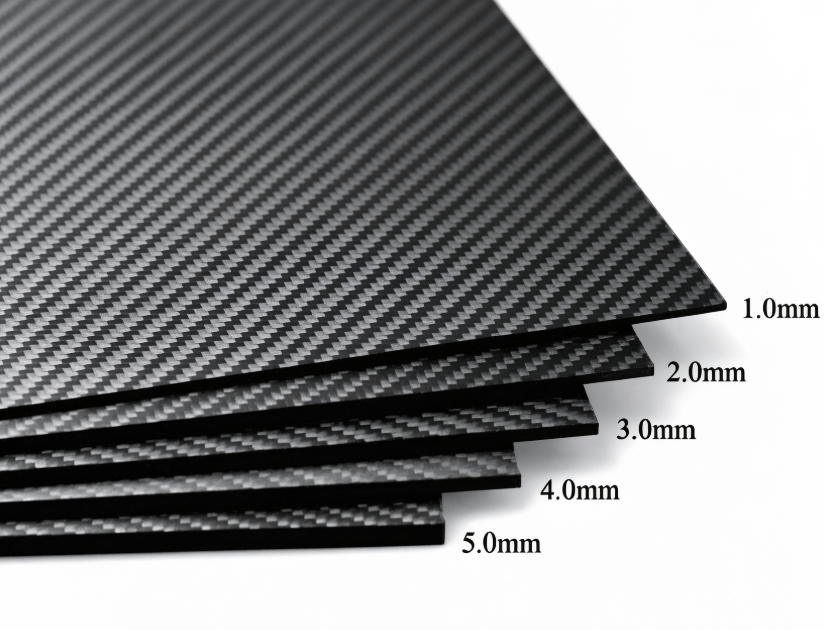
A thicker carbon fiber sheet is not always better. The key is choosing the right thickness.
Many engineers face the same question when purchasing carbon fiber sheets: the dimensions are already confirmed, but should they choose 2 mm, 3 mm, or 5 mm?
If the sheet is too thin, it may lack stiffness and deform easily. If it is too thick, it adds unnecessary weight, cost, and machining difficulty.
Therefore, thickness should be selected based on application, load requirements, weight targets, and machining requirements.
Thickness | Common Applications | Main Characteristics |
0.5–1 mm | Decorative parts, housings | Lightweight, easy to machine |
1–2 mm | Automotive interiors, electronic equipment | Good balance of weight and stiffness |
2–3 mm | Drones, robotics, equipment panels | Versatile for many applications |
3–6 mm | Automotive exteriors, mounting plates | Higher stiffness and load capacity |
6–10 mm | Heavy-duty structural parts | High stiffness and stability |
10 mm+ | Industrial structures, specialized parts | For demanding engineering applications |
These ranges are for initial reference only. Final performance also depends on fiber grade, layup direction, structural design, and manufacturing process.
· Strength & Stiffness: Increasing thickness generally improves bending stiffness and load-bearing capacity, but fiber orientation and layup structure are equally important.
· Weight: For the same dimensions, a thicker sheet weighs more. Lightweight applications should avoid unnecessary thickness.
· Machining & Cost: Thicker sheets provide more machining allowance, but they generally require more machining time and material cost.
· Automotive Interiors: Dashboard trims, door panels, and center-console parts mainly focus on appearance and lightweight design. 1–2 mm can be a good starting range.
· Automotive Exteriors: Front splitters, spoilers, and diffusers need to withstand aerodynamic loads and vibration. 2–4 mm can be used as an initial reference.
· Drones & Robotics: Frames, mounting plates, and connection plates need both low weight and sufficient stiffness. 2–3 mm is a common starting range.
· Industrial Equipment: Standard panels can start at 2–3 mm. Load-bearing or mounting components may require 3–6 mm or more.
1. Define the Application:
Is the sheet for decoration, protection, or structural support?
2. Evaluate the Load:
Consider weight, load direction, and mounting method.
3. Balance Weight and Stiffness:
Meet the required strength and stiffness while avoiding unnecessary thickness.
4. Consider Machining:
Determine whether cutting, drilling, chamfering, or CNC machining is required.
If the required thickness is still unclear, start with a 2 mm or 3 mm prototype, then adjust based on actual testing.
Standard carbon fiber sheets work well for many projects, but custom sizes, thicknesses, and machining requirements often call for a tailored solution.
GBTECH offers a range of carbon fiber sheet specifications, with some products available from approximately 0.5–100 mm in thickness, along with customized length, width, and machining options.
If standard specifications do not meet your requirements, the thickness, dimensions, and machining can be customized for your application.
Choosing a carbon fiber sheet is about finding the right balance between strength, stiffness, weight, cost, and machining requirements.
If you already have drawings, dimensions, application requirements, or quantities, you can submit them to the GBTECH technical team for more suitable material recommendations and an accurate quotation.
Learn more about carbon fiber sheets
Official GBTECH Websites:
EMail: zane@gbtechgroup.cn
Phone: +1 (510)902-9987
www.gbtechgroup.cn | www.gbtechcomposites.com | www.gbtechmaterials.com
US.Office: 38758 Buckboard Common, Fremont, CA 94536, United States
China Head Quaters: Building 1, Left Side, Tangye Road, Xinxu, Huiyang, Huizhou, China


 WhatsApp
 E-mail