When evaluating carbon fiber structures, engineering and procurement teams often ask:
“Could it suddenly break without any warning signs?”
This concern is understandable. Carbon fiber composites have high stiffness and low deformation, so they don't signal impending failure through obvious plastic deformation the way some metals do. But that does not mean carbon fiber failure is entirely unpredictable.
What really matters is: how does damage initiate, how does it propagate, and how can it be detected?
Does carbon fiber really "break suddenly"?
Carbon fiber composites exhibit multiple failure modes. Under sustained or cyclic loading, internal damage such as matrix cracking, interface debonding, and delamination can gradually develop. As damage accumulates, it may eventually lead to fiber fracture.
So while the final break may appear sudden, the damage process leading to it is not necessarily abrupt.
Engineering design must evaluate potential failure in advance by considering material systems, fiber layup, loading conditions, and testing.
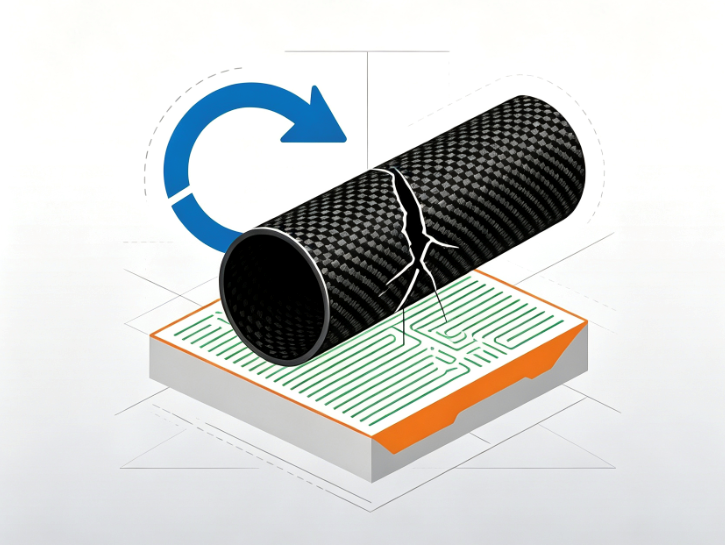
What determines the fatigue life of carbon fiber?
Fatigue life is a key indicator for assessing the long-term reliability of carbon fiber structures.
In engineering, fatigue testing and stress-cycle (S-N) curves are commonly used to study material behavior under repeated loading. However, fatigue life is not a fixed number—it is influenced by fiber type, resin system, layup orientation, load levels, and environmental factors such as temperature and humidity.
For example, a carbon fiber tube subjected primarily to axial loading may exhibit completely different fatigue behavior compared to one subjected to combined bending and torsion.
Therefore, a more valuable question than "How many cycles can carbon fiber withstand?" is:
“Under actual loading and service conditions, what fatigue life can this specific structure achieve?”
Can damage be detected after it occurs?
Yes.
This is a critical part of evaluating the damage tolerance of carbon fiber structures.
After an impact, carbon fiber may show only minor surface marks while internal delamination or matrix damage has already occurred. For safety-critical structures, visual inspection alone is clearly insufficient.
Therefore, engineering selects appropriate non-destructive testing (NDT) methods based on the structural importance and operating scenario.
NDT makes internal conditions assessable
Common NDT techniques include ultrasonic testing, infrared thermography, and acoustic emission testing.
Ultrasonic testing helps identify internal defects such as delamination and voids; infrared thermography can assist in detecting certain internal damage through differences in thermal response; and acoustic emission testing captures characteristic signals generated during loading to help analyze damage activity.
So, "what can't be seen inside can't be controlled" is not sound engineering logic.
A truly reliable approach ensures that potential damage can be detected, evaluated, and controlled.
What should engineering selection really focus on?
For aerospace, robotics, automotive lightweighting, or industrial equipment projects, instead of obsessing over whether carbon fiber "might break suddenly," focus on: material system, fiber layup, actual loading, fatigue testing, manufacturing consistency, and inspection protocols.
These factors are what truly determine the reliability of carbon fiber composites.
Reliability comes from system-level design
Carbon fiber is not a material that "fails without warning."
Its reliability must be evaluated in the context of specific materials, layup architecture, loading, and service environment. When material selection, structural design, manufacturing processes, testing, and quality control form a complete system, carbon fiber becomes a reliable choice for demanding structural applications.
A truly reliable carbon fiber structure is not one that will never fail—but one whose performance can be designed, tested, and verified.
To learn more about carbon fiber products and custom solutions, view product details and request a quote.
https://gbtechmaterials.com/
https://gbtechmaterials.com/SendInquiry/
Official GBTECH Websites:
Email: zane@gbtechgroup.cn
Phone: +1 (510)902-9987
www.gbtechgroup.cn | www.gbtechcomposites.com | www.gbtechmaterials.com
US.Office: 38758 Buckboard Common, Fremont, CA 94536, United States
China Head Quaters: Building 1, Left Side, Tangye Road, Xinxu, Huiyang, Huizhou, China


 WhatsApp
 E-mail