When browsing carbon fiber product specifications, you may often come across designations like:
T300, T700, T800, T1000.
As the numbers get larger, does performance necessarily get stronger?
Many engineers, designers, and procurement professionals new to carbon fiber tend to interpret them as a performance ranking similar to "Grade 300, Grade 700, Grade 800, Grade 1000." But the reality is not that simple.
These names are carbon fiber grade designations, typically associated with the fiber's tensile strength level. The numbers help us quickly assess the approximate performance range of a material, but they are not a simple "performance score."
What truly determines whether a carbon fiber is suitable also includes strength, stiffness, fiber orientation, layup design, manufacturing processes, and cost.
What exactly do the numbers after "T" mean?
Taking major carbon fiber products like those from Toray as an example, the numbers in T300, T700, T800, and T1000 are generally related to the fiber's tensile strength level.
Based on typical product data:
lT300: Tensile strength approx. 3530 MPa, tensile modulus approx. 230 GPa
lT700: Tensile strength approx. 4900 MPa, tensile modulus approx. 230 GPa
lT800: Tensile strength approx. 5490–5880 MPa, tensile modulus approx. 294 GPa
lT1000: Tensile strength approx. 6370 MPa, tensile modulus approx. 294 GPa
As you can see, moving from T300 to T1000, the tensile strength of typical products generally shows an upward trend.
However, here's an important point that is often overlooked: the number after "T" is not a "grade score" for the overall performance of carbon fiber. It is better understood as an indicator of performance positioning among different grades, rather than a simple judgment that "bigger number means better."
High strength does not necessarily mean high stiffness
Understanding carbon fiber grades also requires distinguishing between two frequently confused concepts:
Strength and stiffness are two different things.
Tensile strength represents a material's ability to withstand tensile loads. Higher strength generally means the material can endure greater stress before failure.
Tensile modulus reflects the material's resistance to deformation—in other words, how "easily" it deforms under load.
This is why T300 and T700 both have a typical tensile modulus around 230 GPa, yet T700 has significantly higher tensile strength. In other words, T700 is not simply "harder" than T300—it has a clear advantage in strength.
With T800 and T1000, the typical tensile strength increases further, while the tensile modulus reaches about 294 GPa.
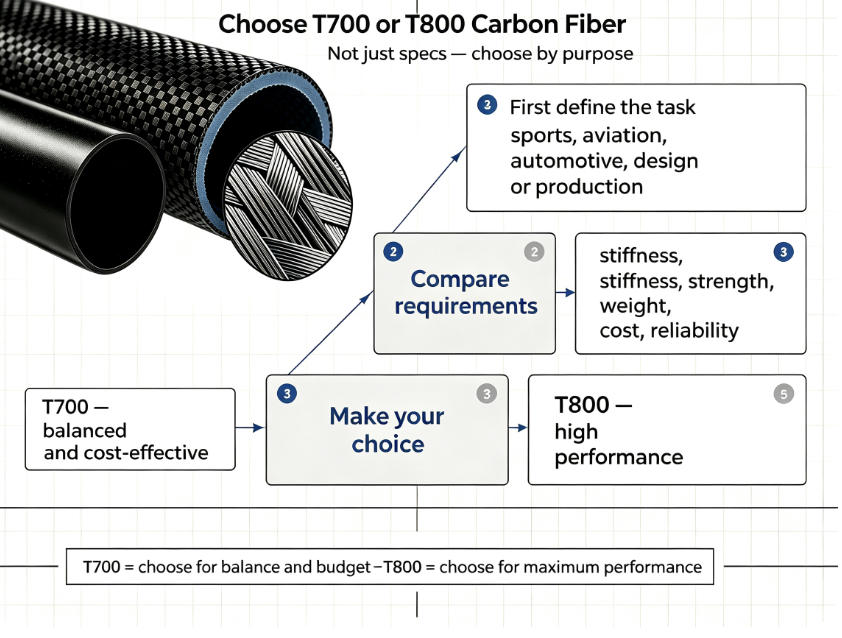
So, when selecting carbon fiber, instead of asking: "Which one has the largest T-number?"
Better to ask first: "What performance does my product need most?"
How should we understand the progression from T300 to T1000?
Looking at these common grades together makes it easier to understand their respective performance positioning.
T300 offers mature, stable overall performance and is a foundational choice for many conventional composite structures. When a product requires strength, weight, and cost to be balanced without pursuing extreme performance, T300 provides a good compromise.
T700 raises the typical tensile strength to about 4900 MPa while maintaining a typical tensile modulus around 230 GPa, making it more suitable for products with higher demands on structural strength and lightweighting.
T800 and T1000 enter the realm of higher-performance options. Typical T800 products offer tensile strength around 5490–5880 MPa, while T1000 reaches about 6370 MPa, with both exhibiting a typical tensile modulus of around 294 GPa.
These differences mean that different grades correspond to different performance requirements.
True material selection cannot rely solely on the grade designation itself—it must also consider the product's actual operating conditions and structural design.
Selecting carbon fiber is more than choosing a "T-number"
The key to understanding T300, T700, T800, and T1000 is not memorizing which number is largest, but understanding the performance characteristics associated with each grade and whether those properties truly align with your product's needs.
If you are developing carbon fiber tubes, sheets, or custom composite structural components, material selection should be based on the actual application scenario, dimensions, loads, weight targets, and performance requirements.
GBTECH can assist in selecting the appropriate carbon fiber grade, layup scheme, and manufacturing process based on your specific product requirements, and supports the development of carbon fiber tubes, sheets, and custom composite products.
https://www.gbtechmaterials.com/SendInquiry/
Official GBTECH Websites:
Email: zane@gbtechgroup.cn
Phone: +1 (510)902-9987
www.gbtechgroup.cn | www.gbtechcomposites.com | www.gbtechmaterials.com
US.Office: 38758 Buckboard Common, Fremont, CA 94536, United States
China Head Quaters: Building 1, Left Side, Tangye Road, Xinxu, Huiyang, Huizhou, China


 WhatsApp
 E-mail