When selecting carbon fiber fabric, you will often come across specifications like 240 GSM, 280 GSM, and 600 GSM.
But what exactly do these numbers represent? Is higher GSM always better?
The answer is not simply "higher is better." GSM affects the fabric's weight, thickness, fiber content, and lamination efficiency. The right choice ultimately depends on your product's structural requirements and manufacturing process.
What is GSM in carbon fiber fabric?
GSM stands for "grams per square meter" and indicates the weight of the fabric per square meter – that is, its areal density.
Generally, a higher GSM means more carbon fiber content per unit area, making the fabric thicker and heavier. For structures that need to build up composite thickness quickly, a higher GSM can reduce the number of layers required, improving production efficiency.
However, there is a trade-off: higher GSM fabrics are usually less conformable to complex curves, and resin wet-out and hand lay-up become more difficult.
So, GSM is not about "higher is better" – it's about matching the fabric to the product's needs.
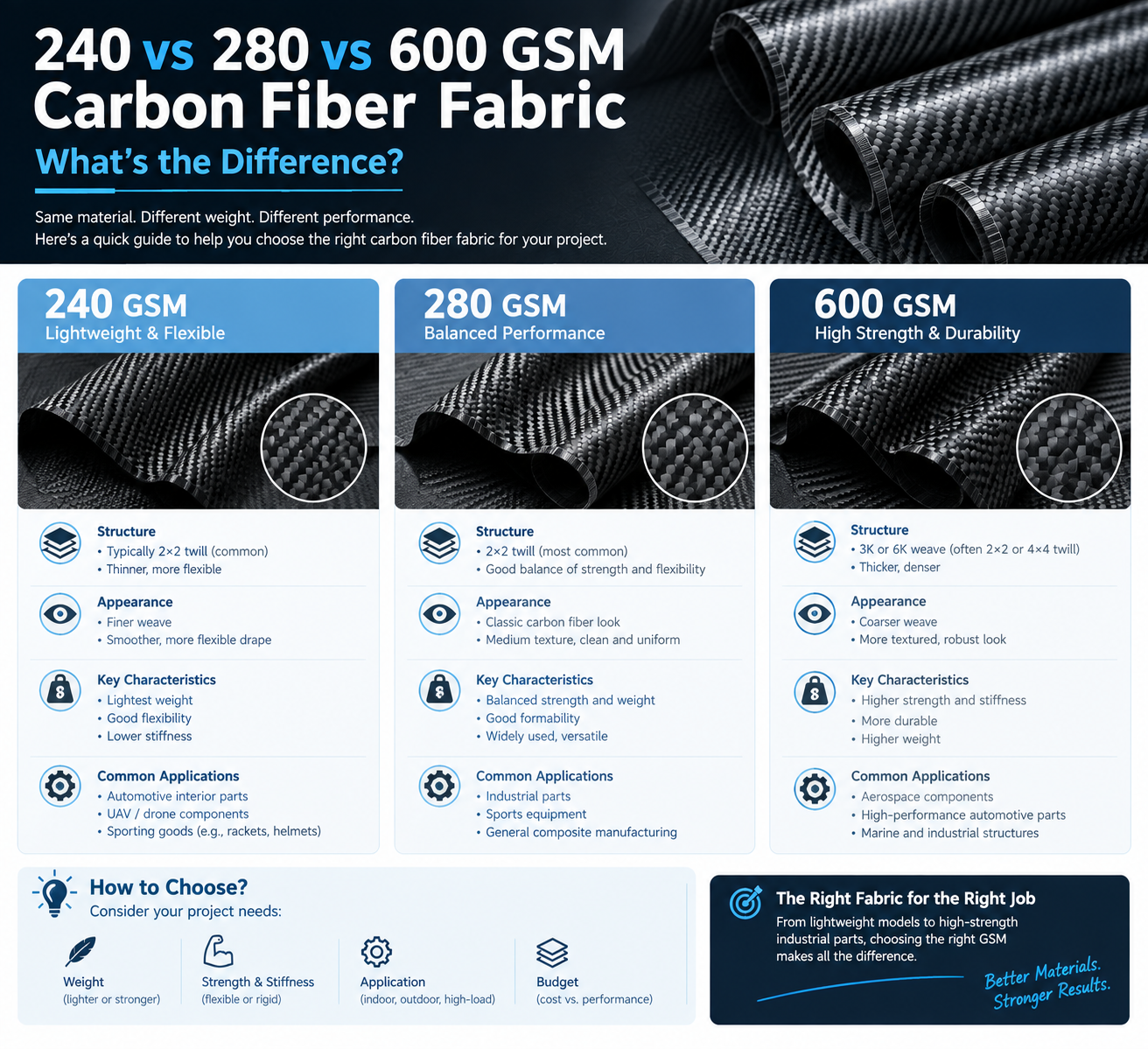
What are the differences between 240, 280, and 600 GSM?
Specification | Tow Size | Typical Thickness | Weave Characteristics | Typical Applications |
240 GSM | 3K | ~0.23 mm | Fine, uniform | Surface layers, automotive interiors, sporting goods, drones |
280 GSM | 3K | ~0.28 mm | Higher fiber density | Structural reinforcement, aerospace, industrial components |
600 GSM | 12K | ~0.6 mm | Heavy tow, high areal weight | Large structures, wind power, infrastructure repair |
240 GSM typically offers good handling and surface finish, making it suitable for products with requirements on both weight and appearance. 280 GSM provides a more balanced combination of weight, thickness, and structural performance, making it suitable for composite parts that need a certain load-bearing capacity. 600 GSM falls into the heavy-weight category, allowing for rapid thickness build-up and higher fiber content with fewer layers, making it more suitable for large structures and applications requiring high fiber volume fraction.
How to choose based on your project needs?
When selecting GSM, instead of fixating on the number, ask yourself three questions: What are the weight constraints of the product? What level of structural performance is needed? What manufacturing process will be used?
If your project prioritizes light weight, surface finish, and ease of handling, 240 GSM is usually the better choice. This is especially true for complex curves, cosmetic parts, and hand lay-up processes, where lighter fabrics are often easier to control.
If you need a balance between weight, thickness, and structural performance, consider 280 GSM. It suits applications that require a certain load capacity without adding excessive weight.
If your goal is to build up thickness quickly and increase fiber content per unit area, 600 GSM has advantages. However, these heavy fabrics demand more from resin wet-out and lay-up processes, making them better suited for techniques like vacuum infusion and prepreg processing.
Beyond GSM, remember that other factors – such as 3K vs. 12K tow, plain vs. twill weave, fiber grade, and lay-up orientation – also significantly affect the final composite's performance and appearance.
Is higher GSM really better?
Not necessarily.
240, 280, and 600 GSM address different needs: 240 GSM emphasizes lightness and ease of handling, 280 GSM focuses on a balance between performance and weight, while 600 GSM is better for large structures and rapid thickness build-up.
The right choice is not about pursuing the highest GSM, but about ensuring the fabric specification, product structure, and manufacturing process are well matched.
If you are comparing different fabric specifications, you can provide information on your product's application, dimensions, and processing methods. GBTECH can assist you in determining the most suitable areal weight, fiber specification, and weave style.
https://gbtechmaterials.com/SendInquiry/
https://gbtechmaterials.com/carbonfiberfabric/
Official GBTECH Websites:
Email: zane@gbtechgroup.cn
Phone: +1 (510)902-9987
www.gbtechgroup.cn | www.gbtechcomposites.com | www.gbtechmaterials.com
US.Office: 38758 Buckboard Common, Fremont, CA 94536, United States
China Head Quaters: Building 1, Left Side, Tangye Road, Xinxu, Huiyang, Huizhou, China


 WhatsApp
 E-mail