Many people wonder when first working with carbon fiber sheets: can this material be processed directly like aluminum?
The answer is yes. However, the machining characteristics of carbon fiber sheets differ from those of metal sheets. Cutting, drilling, and CNC machining are all achievable, but if the tooling, parameters, or support methods are incorrect, problems such as delamination, fraying, fiber pull-out, and dimensional deviations can occur.
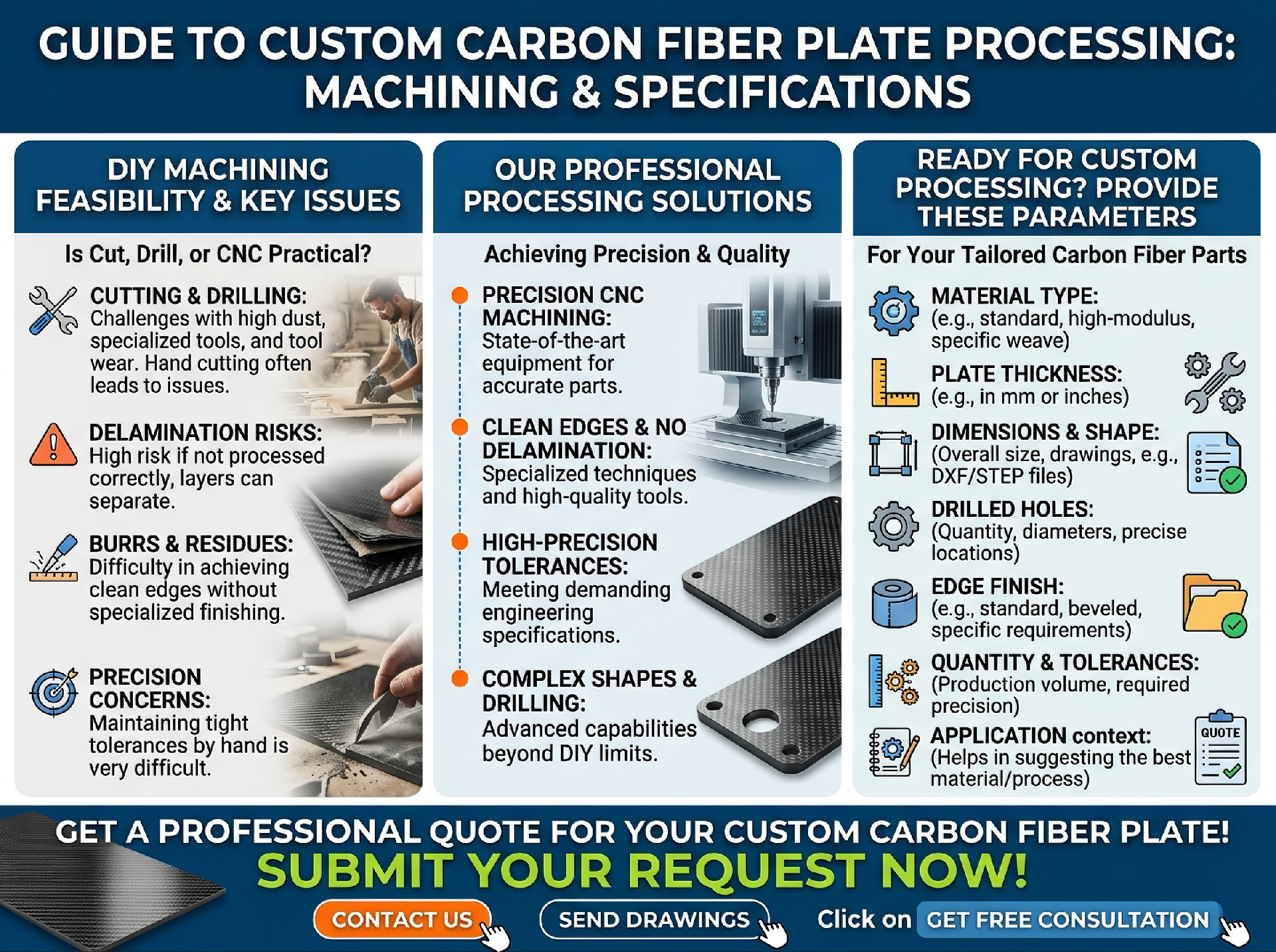
What machining methods are available for carbon fiber sheets?
Common machining methods for carbon fiber sheets include cutting, drilling, milling, and CNC machining.
For relatively simple parts, basic processing can be completed through cutting and drilling. For more complex shapes such as equipment panels, mounting brackets, and enclosures, CNC machining can be used to perform contours, hole positioning, counter-sinking, and chamfering.
The key is not "whether it can be machined," but choosing the right process for the job.
Why do cut edges require special attention?
Cutting may seem simple, but it is one of the steps most likely to reveal processing quality issues.
If the tool is unsuitable or the cutting force is excessive, the edges of the carbon fiber sheet may experience fraying, fiber pull-out, or even localized delamination. This is especially true for thin sheets and complex contours, where cutting conditions must be carefully controlled.
Therefore, wear-resistant tools are typically selected, and cutting speed and feed rate are adjusted based on sheet thickness and structure. For parts with high cosmetic requirements, the edges can be further finished after machining to achieve cleaner contours.
How to reduce delamination during drilling?
Drilling is a stage where problems are more likely to occur in carbon fiber sheet processing.
When the drill bit approaches the exit side of the sheet, if there is insufficient support, the fibers and resin layers may be pulled outward, causing delamination at the exit. This issue is particularly noteworthy for thin sheets, larger hole diameters, and high-precision hole machining.
In practice, choosing drill bits designed for composites, controlling the feed rate, and adding backup support on the backside of the sheet can help. A single hole can directly affect the assembly accuracy of the entire part.
What are the requirements for tooling and temperature in CNC machining?
For complex parts, CNC machining can achieve more precise contours and hole features, but it also places higher demands on tooling and machining parameters.
Carbon fiber itself is highly abrasive, and tool wear is typically more pronounced than when machining ordinary plastics. At the same time, the resin matrix of carbon fiber sheets is sensitive to excessive heat. Continuous cutting heat can soften the resin, affecting the machined surface and dimensional stability.
Therefore, the overall machining process requires comprehensive adjustment of tools, spindle speed, feed rate, and toolpath, rather than simply applying metal machining parameters.
Dust management is equally important
One often overlooked issue is carbon fiber dust.
The fine dust generated during machining not only affects the working environment but is also electrically conductive. If a large amount enters equipment, it may affect electrical components.
Therefore, an effective dust extraction system should be used during machining, along with necessary personal protective equipment, to minimize dust accumulation in the equipment and work area.
Confirm these parameters before custom processing
If you need to machine carbon fiber sheets into specific parts, the more complete the upfront information, the smoother the subsequent processing.
Typically, you should confirm:
Sheet thickness, material specification, fiber orientation, part dimensions, hole diameters, machining tolerances, surface finish requirements, and order quantity.
If you already have part drawings, you can provide them directly. Based on the specific structure and machining requirements, the appropriate processing method can then be determined.
From standard sheets to custom parts
The machining methods for carbon fiber sheets differ from those for metal materials. Cutting focuses on edge quality, drilling focuses on delamination, and CNC machining must simultaneously consider precision, tool wear, and temperature control.
For projects requiring custom parts, the material itself is only the first step. From sheet selection to final machining, process compatibility is equally important.
GBTECH can provide carbon fiber sheets as well as custom services including cutting, drilling, and CNC machining, based on your dimensions, drawings, and processing requirements.
https://gbtechmaterials.com/SendInquiry/
https://gbtechmaterials.com/Carbon-Fiber-Sheets/
Official GBTECH Websites:
Email: zane@gbtechgroup.cn
Phone: +1 (510)902-9987
www.gbtechgroup.cn | www.gbtechcomposites.com | www.gbtechmaterials.com
US.Office: 38758 Buckboard Common, Fremont, CA 94536, United States
China Head Quaters: Building 1, Left Side, Tangye Road, Xinxu, Huiyang, Huizhou, China


 WhatsApp
 E-mail