A piece of equipment is calibrated at room temperature. Why can its positioning reference shift when the temperature changes?
For precision machinery, measurement equipment, and optical support structures, this type of issue cannot be explained only by stiffness or machining accuracy. Materials themselves change dimensions with temperature, and as structural accuracy requirements become more demanding, thermal deformation may need to be treated as an independent design factor.
Carbon fiber composites can achieve a very low coefficient of thermal expansion in certain directions, which is why they are often used in structures where dimensional stability is important. However, one point needs to be made clear first:
Low thermal expansion in carbon fiber does not mean that a carbon fiber structure will not expand or contract with temperature.
The dimensional change of an actual carbon fiber component also depends on the fibers, resin, layup, and overall structural design.
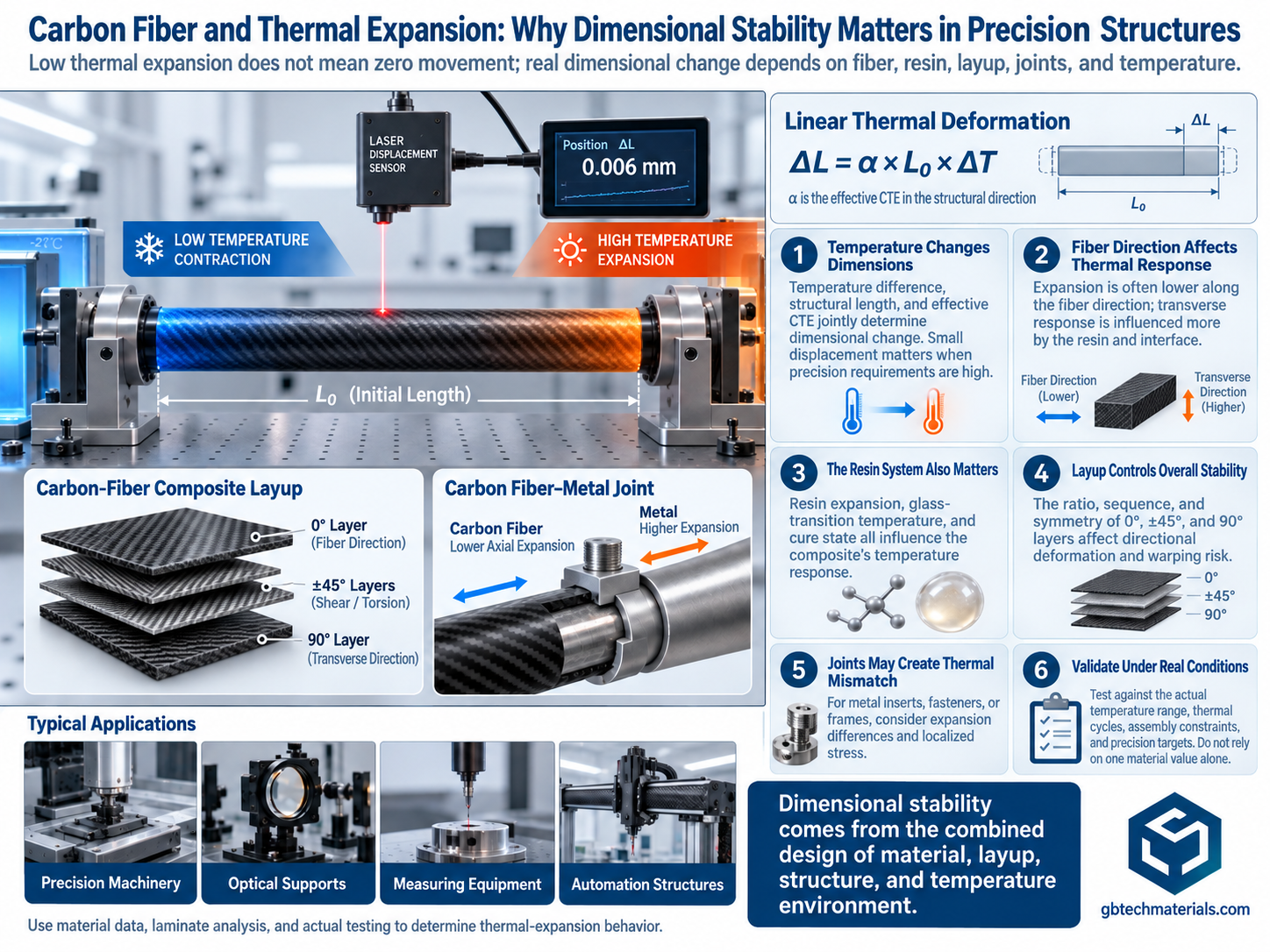
The dimensional change of a material with temperature is commonly described by its coefficient of thermal expansion, or CTE.
Carbon fibers generally have a low CTE along the fiber axis, and some high-modulus fiber types may even exhibit negative values. However, the actual value depends strongly on the specific fiber type and should not be generalized.
When carbon fibers are incorporated into a polymer matrix, the continuous fibers strongly restrain the thermal expansion of the matrix along the fiber direction. As a result, unidirectional carbon fiber composites can also achieve a relatively low CTE along the fiber axis.
But an engineering component is not a single fiber. It is a composite made up of fibers, resin, and plies oriented in different directions.
Therefore, the final CTE is influenced by factors such as fiber type, resin system, fiber volume fraction, ply orientation, and laminate architecture. Thermal expansion can also differ significantly between different directions.
Carbon fiber composites are strongly anisotropic.
In a unidirectional material, for example, the high axial stiffness of fibers aligned in the 0° direction strongly influences the thermal expansion response along that direction.
Transverse thermal expansion, however, is governed by the combined behavior of the fibers, the matrix, and the constraint between them. The axial CTE therefore cannot simply be used to represent transverse behavior.
When plies with different orientations are combined into a laminate, the situation becomes more complex. The individual plies constrain one another, while both the proportion and stacking sequence of the plies influence the thermal response of the overall laminate.
If the structure or layup is asymmetric, temperature changes may also produce bending or warpage.
For precision structures, the key question should therefore not only be “How low is the CTE?” but also “Will the structure maintain the required geometry after the temperature changes?”
The resin matrix is another important factor in the thermal dimensional stability of a carbon fiber composite.
Different resin systems have different thermal expansion and thermomechanical properties. The glass transition temperature, or Tg, also needs to be considered.
As the operating temperature approaches Tg, thermomechanical properties of the polymer matrix, including its modulus, may decrease significantly. This can affect how the structure deforms under thermal loading.
For this reason, material selection should be based on the actual operating temperature range rather than relying only on CTE data measured at room temperature.
In precision positioning systems, thermal deformation can shift reference positions.
In measurement equipment, dimensional drift in the structure can become part of the measurement error.
In optical support structures, deformation may change the relative positions of optical components.
If a carbon fiber structure is also connected to aluminum, steel, or other materials, differences in CTE between the materials must also be considered.
In this situation, the real design objective is not simply to control the CTE of one individual component, but to manage relative displacement and thermally induced stress throughout the complete assembly over the target temperature range.
For this type of structure, it is advisable to first define the operating temperature range, allowable dimensional change, critical dimensional directions, and connection methods.
Fiber orientation, laminate proportions, resin system, and structural configuration can then be selected around those requirements.
For projects with demanding precision requirements, thermoelastic analysis or coupled thermal-structural analysis should also be considered under representative operating conditions.
Where necessary, thermal cycling and dimensional measurements can be used to verify the stability of the actual structure.
If you are developing precision equipment supports, measurement structures, optical supports, or other components with demanding dimensional stability requirements, you can provide GBTECH with the structural dimensions, operating temperature range, allowable dimensional change, critical directions, and connection methods.
These parameters can then be used to evaluate suitable materials, laminate configurations, and manufacturing approaches for the specific operating conditions.
Send Inquiry:https://gbtechmaterials.com/SendInquiry/
View Carbon Fiber Sheet Specifications:https://gbtechmaterials.com/Carbon-Fiber-Sheets/
View Carbon Fiber Tube Specifications:https://gbtechmaterials.com/Carbon-Fiber-Tubes/
Official GBTECH Websites:
EMail: zane@gbtechgroup.cn
Phone: +1 (510)902-9987
www.gbtechgroup.cn | www.gbtechcomposites.com | www.gbtechmaterials.com
US.Office: 38758 Buckboard Common, Fremont, CA 94536, United States
China Head Quaters: Building 1, Left Side, Tangye Road, Xinxu, Huiyang, Huizhou, China


 WhatsApp
 E-mail