Carbon fiber tubes used in sports equipment may look like simple tubular components, but many factors can influence the final product performance.
Weight, stiffness, torsional behavior, taper, dimensional tolerances, and surface quality often need to be considered at the same time.
For this reason, tube development should not focus only on fiber grade, nor should the manufacturing process be selected before the product requirements are clear.
A more reasonable approach is to first define the performance targets and structural requirements, then match them with the appropriate material, layup design, and manufacturing method.
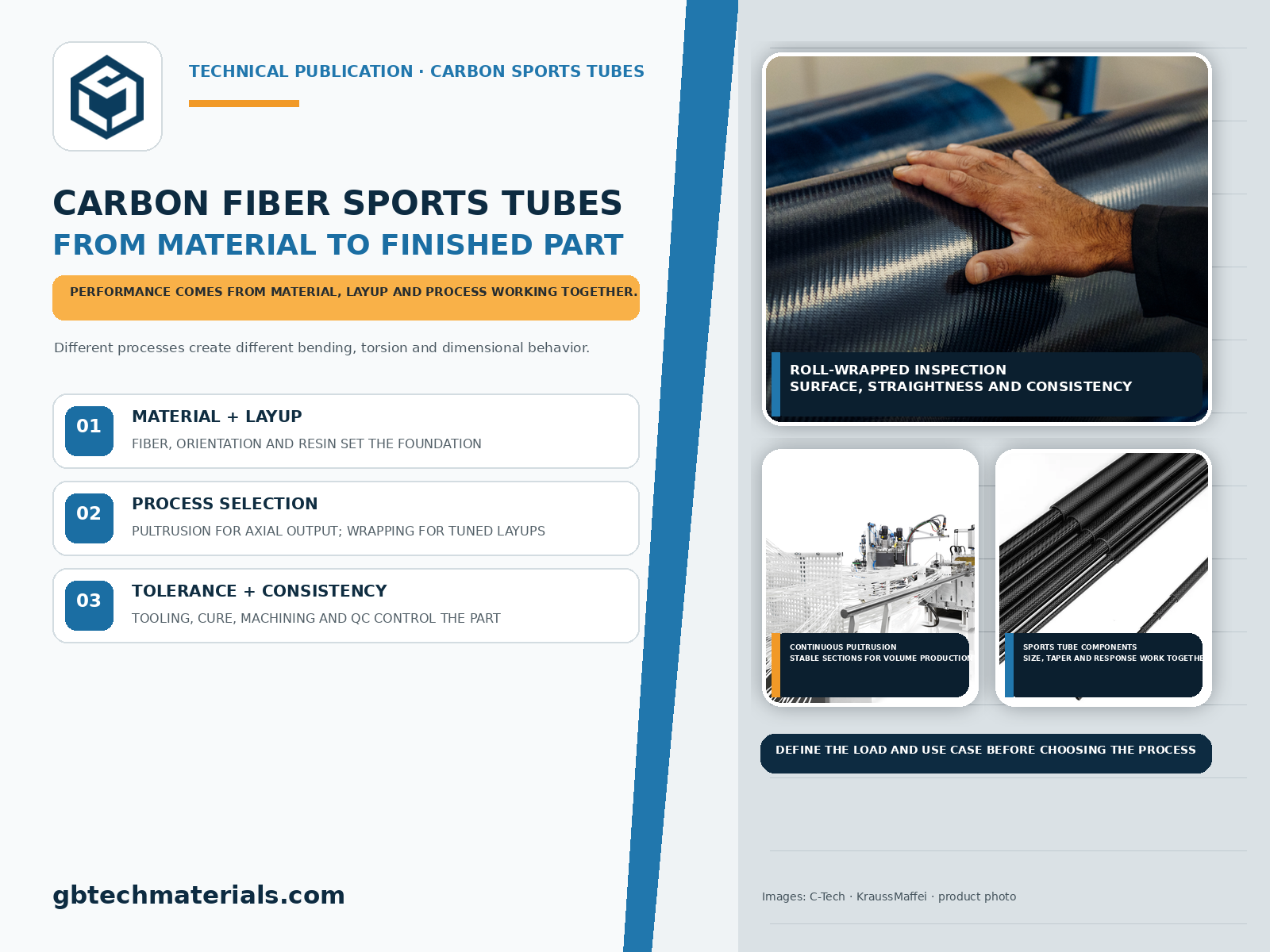
Roll-wrapping typically involves placing prepreg at designed fiber angles and wrapping it around a mandrel before curing.
Its main advantage is high layup flexibility. It is well suited to tubes that require taper, local reinforcement, or specific bending characteristics, which is why it is commonly used for golf shafts, fishing rods, and some high-performance sports tubes.
Filament winding uses continuous fibers wound around a mandrel along controlled paths.
It is suitable for axisymmetric tubular structures and can continuously place helical or near-hoop fibers to tune shear, torsional, and circumferential performance.
However, its flexibility for complex local layups is generally lower than that of roll-wrapping.
Pultrusion is more suitable for continuous production of constant-cross-section tubes.
The structure is usually dominated by axial reinforcement, offering good dimensional repeatability and high production efficiency, which makes it suitable for standardized products.
However, if the tube requires significant taper, local wall-thickness changes, or complex layups, pultrusion becomes less adaptable.
So there is no manufacturing process that is always “better.”
The key is whether the process matches the product geometry and performance requirements.
Fiber angles in a carbon fiber tube are usually defined relative to the tube axis.
0° fibers mainly affect axial stiffness and bending performance.
±45° plies contribute more to shear and torsional behavior.
Fibers close to 90° provide additional circumferential stability to the tube wall.
Even when the same T700 carbon fiber is used, differences in layup ratio, stacking sequence, and local thickness can result in noticeably different weight, stiffness, and torsional response.
Therefore, sports-equipment tubes should not be selected only by outer diameter, inner diameter, and length.
It is also important to define whether the product prioritizes stiffness, torsional behavior, bending profile, or lightweighting.
Wall thickness affects both weight and stiffness.
Outer diameter, inner diameter, roundness, straightness, and length directly affect downstream assembly.
If the tube needs to be bonded, sleeved, or fitted with metal components, local dimensional deviations can directly influence connection quality.
For tapered tubes, taper consistency is also important because it affects stiffness and weight distribution along the length.
In volume production, what really matters is not whether one sample performs well.
The more important question is whether different batches can maintain similar dimensions and performance.
Sports equipment often has high appearance requirements, but a glossy finish, matte surface, or clear carbon pattern does not directly indicate internal structural quality.
Coating and sanding mainly affect appearance, wear resistance, and feel.
Wrinkles, voids, local resin-rich or resin-starved areas, and fiber misalignment can influence structural performance.
Whether these defects are critical depends on their location, size, and the actual loading requirements of the product.
The core of carbon fiber tube manufacturing is not choosing the process first, but defining what performance the product needs to achieve.
If you are developing carbon fiber tubes for sports equipment, you can provide GBTECH with the outer diameter, inner diameter, length, taper, target weight, stiffness, torsional requirements, assembly tolerances, surface requirements, and estimated quantity.
Based on these conditions, the material system, layup design, and manufacturing route can then be determined.
Send Inquiry:https://gbtechmaterials.com/SendInquiry/
View Carbon Fiber tube Specifications:https://gbtechmaterials.com/Carbon-Fiber-Tubes/
Official GBTECH Websites:
EMail: zane@gbtechgroup.cn
Phone: +1 (510)902-9987
www.gbtechgroup.cn | www.gbtechcomposites.com | www.gbtechmaterials.com
US.Office: 38758 Buckboard Common, Fremont, CA 94536, United States
China Head Quaters: Building 1, Left Side, Tangye Road, Xinxu, Huiyang, Huizhou, China


 WhatsApp
 E-mail