From X‑ray examination tables and patient positioning systems to surgical robots and medical device structural components, carbon‑fiber composite materials are gaining increasing applications in the medical device sector.
The reasons are straightforward.
Medical devices frequently demand lightweight design, structural stability, durability, and material properties suited for special environments. Conventional metals can address some of these requirements, while carbon fiber offers engineers an alternative option.
Why is carbon fiber suitable for medical devices?
1. Lighter weight with preserved structural rigidity
Moving components in medical devices are highly weight‑sensitive.
For instance, surgical robot arms, mobile imaging equipment and patient positioning systems benefit from reduced structural weight, which lowers motion loads and allows greater flexibility in device structural design.
Carbon‑fiber composites generally have a significantly lower density than aluminum and titanium alloys, alongside high specific stiffness, making them ideal for components requiring both low weight and sound structural performance.
2. Excellent X‑ray transmission performance
This constitutes a critical advantage of carbon fiber for medical imaging devices.
In X‑ray, CT and other imaging equipment, structures within the imaging path must minimize interference with radiation and image quality.
Compared with metallic materials, carbon‑fiber composites deliver favorable radiation transmission properties, so they are widely used for:
lX‑ray table tops
lCT patient support structures
lPatient positioning boards
lRadiotherapy positioning equipment
lOther structural parts for imaging systems
This accounts for the high application value of carbon fiber within medical imaging equipment.
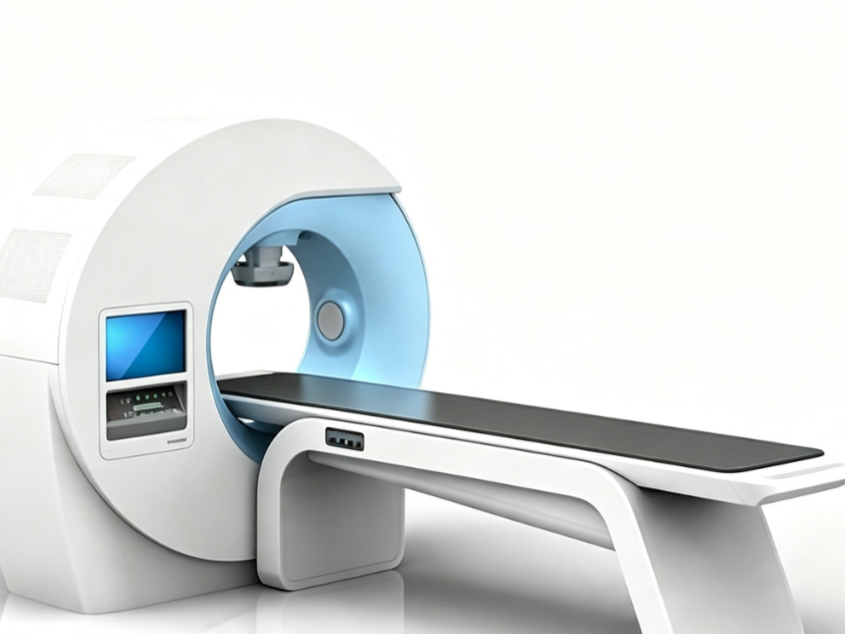
A Typical Application: Carbon‑Fiber X‑ray Examination Tabletop
An X‑ray examination tabletop may appear structurally simple, yet it imposes two critical requirements on materials:
it must stably support patients while minimizing interference with imaging.
Traditional metal structures can cause significant X‑ray attenuation or interference. Carbon‑fiber delivers structural support while maintaining excellent X‑ray transmission performance.
Accordingly, carbon‑fiber panels and custom composite structures are widely adopted in patient‑support systems for medical imaging equipment.
For equipment manufacturers, material selection is far more than simply “replacing metal with carbon‑fiber”. Comprehensive factors must be considered:
dimensions, thickness, load‑bearing requirements, ply design, surface treatment and machining precision.
This is where custom carbon‑fiber manufacturing expertise delivers value.
What Other Medical Devices Can Use Carbon‑Fiber?
Beyond imaging tabletops, carbon‑fiber can be implemented in numerous medical‑device structures.
Surgical robots represent a noteworthy application area. For robot arms and moving mechanisms, lower structural weight reduces moment of inertia, while high stiffness helps maintain structural stability.
Additionally, carbon‑fiber can be evaluated for use in patient positioning systems, medical equipment supports, device enclosures and other structural components requiring lightweight design, based on specific operating conditions.
Material requirements vary across different medical devices. Therefore, the key is not to arbitrarily select a certain type of carbon‑fiber, but to choose appropriate materials, structures and manufacturing processes tailored to real‑world applications.
What Can GBTECH Offer for Medical‑Device Projects?
With over 20 years of experience in carbon‑fiber composite manufacturing, GBTECH provides solutions aligned with diverse project requirements:
Suitable for equipment panels, support structures and components requiring further CNC machining.
Suitable for lightweight supports, mechanical frameworks and moving parts.
lCNC Precision‑Machined Carbon‑Fiber Components
Cutting, drilling, slotting and other precision machining services available per customer drawings.
lCustom Carbon‑Fiber Structural Parts
Custom manufacturing support for special dimensions, configurations, performance specifications and production volumes.
From prototype development and small‑batch testing to subsequent mass production, we collaborate with customers to assess suitable materials and manufacturing solutions based on drawings and practical application requirements.
If you are developing medical‑imaging equipment, patient positioning systems, surgical robots or other lightweight medical‑device structural components, please send your drawings, dimensions or application requirements to GBTECH.
Our engineering team will assist in evaluating carbon‑fiber materials and manufacturing solutions for your specific project.
www.gbtechmaterials.com
marketing@gbtechgroup.cn
Official GBTECH Websites:
EMail: zane@gbtechgroup.cn
Phone: +1 (510)902-9987
www.gbtechgroup.cn | www.gbtechcomposites.com | www.gbtechmaterials.com
US.Office: 38758 Buckboard Common, Fremont, CA 94536, United States
China Head Quaters: Building 1, Left Side, Tangye Road, Xinxu, Huiyang, Huizhou, China


 WhatsApp
 E-mail