In the modern industrial landscape, where lightweight performance and high strength go hand in hand, carbon fiber has emerged as a material of choice. Its exceptional strength-to-weight ratio far surpasses that of traditional materials like steel or aluminum, making it indispensable in high-end manufacturing. Among its many forms, carbon fiber tubing stands out for its structural stability and superior mechanical properties. These seemingly simple tubes are widely used in aerospace, medical devices, sports equipment, smart devices, and beyond. Behind their clean, minimalist appearance lies a complex manufacturing process and a rich world of surface aesthetics.
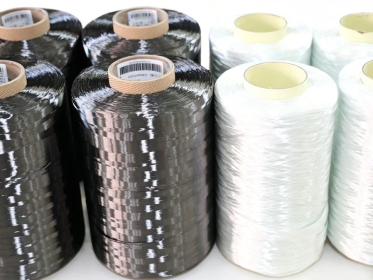
The journey of a carbon fiber tube begins with thin, flexible strands of carbon fiber yarn. While each individual filament is lightweight and incredibly strong, fibers alone cannot be used directly in load-bearing structures. They must be bound together into a stable, unified form. The primary method for achieving this is the carbon fiber winding process.
High-precision winding machines control the carbon fiber yarns under constant tension, layering them along a mandrel at carefully designed angles and paths. The fibers are evenly arranged, layer by layer, and impregnated with a resin matrix. Once the resin cures, the loose, soft fibers transform into a rigid, high-strength tube blank.
This winding technique does more than just bind fibers—it unlocks the full potential of carbon fiber. By adjusting the winding angle and sequence, manufacturers can tailor the tube’s performance to different stress conditions, maximizing axial tensile strength and ensuring stability under various loads.
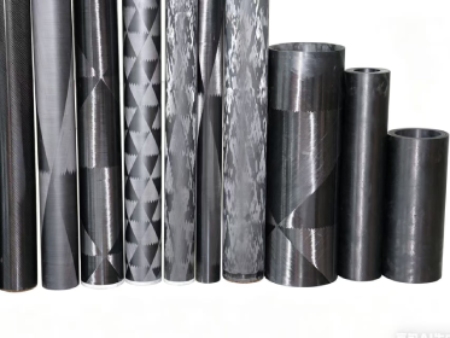
Once formed, a carbon fiber tube is far from a one-look product. Through different surface treatment processes, it can display a range of distinctive textures and visual styles.
One of the most recognizable is the forged carbon pattern (often referred to as forged composite). Its irregular, layered texture creates natural light-to-dark transitions that give the surface depth and character. This finish blends the ruggedness of industrial manufacturing with a unique, almost artistic visual appeal.
Beyond the forged look, carbon fiber tubes can be polished, coated, matte-finished, or sanded to achieve:
Smooth, mirror-like surfaces
Fine fabric weaves (e.g., plain or twill weave)
Sleek matte or satin textures
These options allow carbon fiber tubes to serve not only as functional components but also as visually striking design elements.
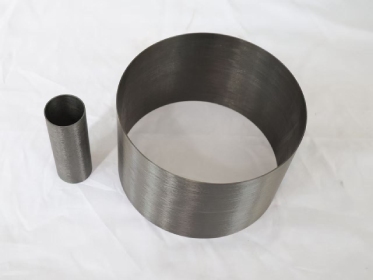
Perhaps one of the most remarkable features of carbon fiber tubing is its ability to remain extremely lightweight without sacrificing strength. Thanks to mature winding processes and precise material control, tube wall thickness can be accurately brought down to 1 millimeter. At this scale, the tube retains excellent rigidity and resistance to deformation while significantly reducing overall weight. This makes carbon fiber tubing ideal for weight-sensitive, space-constrained applications—from high-end drones and robotics to portable medical devices and aerospace structures.
From flexible yarn to precision tube, from winding to surface refinement, carbon fiber tubing is more than just an industrial product—it is a fusion of materials science and process aesthetics. Lightweight, strong, and remarkably versatile in appearance, it continues to unlock new possibilities across a growing range of industries. Whether hidden inside a structural frame or showcased as a design feature, carbon fiber tubing represents the quiet evolution of how we build—stronger, lighter, and more beautiful.
Official GBTECH Websites:
EMail: zane@gbtechgroup.cn
Phone: +1 (510)902-9987
www.gbtechgroup.cn | www.gbtechcomposites.com | www.gbtechmaterials.com
US.Office: 38758 Buckboard Common, Fremont, CA 94536, United States
China Head Quaters: Building 1, Left Side, Tangye Road, Xinxu, Huiyang, Huizhou, China


 WhatsApp
 E-mail